An H100 for $2.89 an hour, billed by the second, with free egress. That is RunPod's pitch in 2026, and the numbers are real: an RTX 4090 costs $0.69/hr, an A100 starts at $1.39/hr, and the cheapest usable card, the RTX A5000, runs $0.27/hr. The same product sits at 3.5/5 on Trustpilot across 231 reviews. Both facts are accurate, and understanding why tells you how to use RunPod well.
What RunPod actually is#
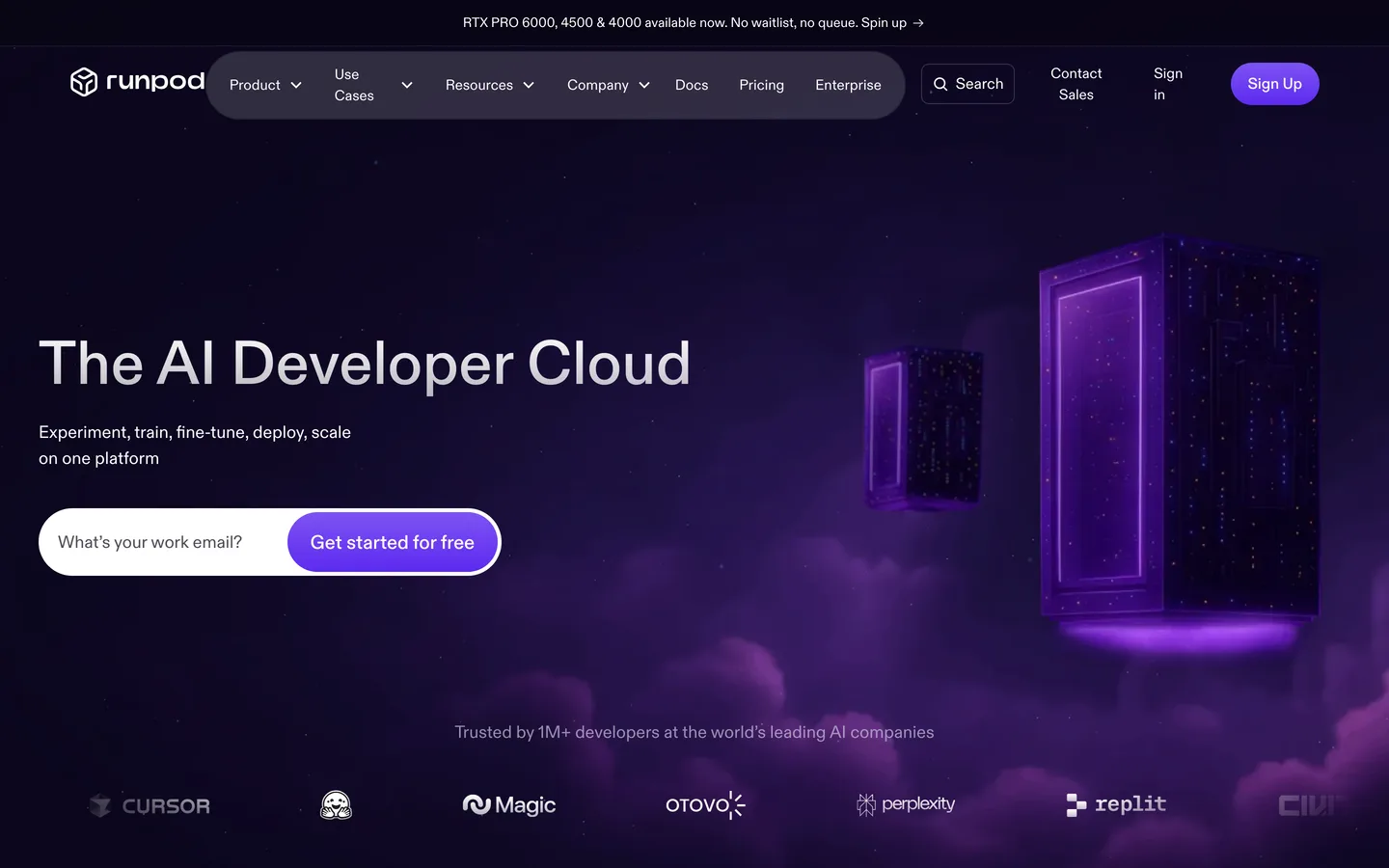
RunPod is a GPU cloud built for AI workloads: on-demand pods you pay for by the second, serverless endpoints that scale to zero between requests, and Instant Clusters for multi-node training without a sales call. FlashBoot keeps serverless cold starts under 200ms, which is the difference between scale-to-zero as a demo and scale-to-zero as something you can put behind a user-facing API. Founded in 2022, the platform claims 750,000+ developers, with teams at Hugging Face, Perplexity, and Cursor among them.
The economics against hyperscalers are not close. Beyond the hourly rates, the structural win is egress: moving datasets in and trained weights out costs nothing on RunPod, where AWS, GCP, and Azure charge $0.09-0.12/GB on the way out. For the download-weights, fine-tune, ship-weights loop that defines open-source AI work, that difference compounds every cycle. We ran the local-hardware version of this math in our piece on open-source AI in 2026; RunPod is what the rent-instead branch of that decision tree looks like.
What the 3.5 measures#
The Trustpilot complaints barely mention price. They mention meters that keep running.
Three patterns repeat across reviews. First, pods that fail to start or crash mid-job while billing continues, burning credits before any work happens. Second, the storage trap: a stopped pod is not a free pod. Its volume disk bills at $0.20/GB/mo, double the running rate, and multiple users report low-balance warnings from pods they believed were off. Third, availability: GPU supply fluctuates at peak times, and the dashboard has shown cards as available that were not. Spot pricing has also been changed abruptly in the past, raised 25%, then removed, then re-gated behind the API.
None of this is hidden, but none of it is on the pricing page either. It is the operational texture of a platform that optimizes aggressively for price, and it rewards users who plan for it.
How to use RunPod without surprises#
The defensive playbook is short. Checkpoint training runs so a crashed pod costs minutes, not hours. Delete pods when you are done, never just stop them; anything worth keeping belongs on a network volume at $0.07/GB/mo, which survives deletion. Keep the default $80/hr spend cap, or lower it if your usage is occasional. And for serverless, do the duty-cycle math: H100 time costs $4.55/hr serverless against $2.89/hr as a pod, so above roughly 60% sustained utilization the plain pod wins.
Follow those four rules and RunPod is what it appears to be: the cheapest serious GPU compute you can buy in 2026. Skip them and you join the Trustpilot reviews. This is the same lesson usage-based AI pricing keeps teaching, which we covered in the hidden costs of credit-based AI tools: the meter is the product, and the meter does not pause because you stopped paying attention.
Our full breakdown of pods, serverless, clusters, storage pricing, and the honest pros and cons is in the RunPod guide.