The advertised price is a lie#
Every credit-based AI tool shows you a headline price. Midjourney Basic at 10 $, Runway Standard at 15 $, Cursor Pro at 20 $, ElevenLabs Creator at 22 $.
These numbers are technically true, but they are also designed to set your expectations lower than reality. The actual bill at the end of the month is almost always higher, because credits run out faster than the marketing suggests, and the overage pricing is usually worse than the base subscription math.
I keep my own invoices across the tools I use for client work and aitoolradar.io. Here is what three months of real bills actually looked like, and what that tells you about how to budget.
How credit systems actually work#
Before the numbers, a quick mental model. Subscription-based AI pricing splits roughly into three patterns:
Flat rate: Claude Pro at 20 $, ChatGPT Plus at 20 $. You pay, you get usage, rate limits kick in if you are abusive, but there is no credit meter. This is the cleanest pricing model.
Credit-based with clear exchange rates: Midjourney gives you GPU minutes, Runway gives you credits that map to video seconds. You can calculate roughly how many generations you will get. Overage either stops you cold or charges extra.
Credit-based with fuzzy exchange rates: Cursor, ElevenLabs, Canva AI. Credits map to "requests" or "characters" or "generations", but different operations cost different amounts, and the tool often does not tell you the cost before you run the operation. This is where the bill creeps.
The pattern that burns people is the third one. You think you have a 20 $ Pro plan. You actually have a 20 $ starter bucket plus metered consumption that you cannot easily predict.
Three months of actual bills#
Here are the numbers, averaged across January through March 2026. I use all of these for real work, not testing.
Midjourney Standard (30 $/mo)
- Advertised: 15 hours of fast GPU time per month
- Actual usage: 14-18 hours, usually tight
- Overage: I hit the relax queue about twice a month, no extra charge but slower
- Real monthly cost: 30 $ consistently
- Verdict: honest pricing, stays close to the headline number
Runway Standard (15 $/mo)
- Advertised: 625 credits per month
- Actual usage: 625 credits burned in the first 10 days during active production, then I wait or buy more
- Overage: extra credit packs at roughly 0,012 $ per credit
- Real monthly cost: 15-80 $ depending on the month
- Verdict: the base plan is a teaser, the Pro plan at 35 $ is closer to usable
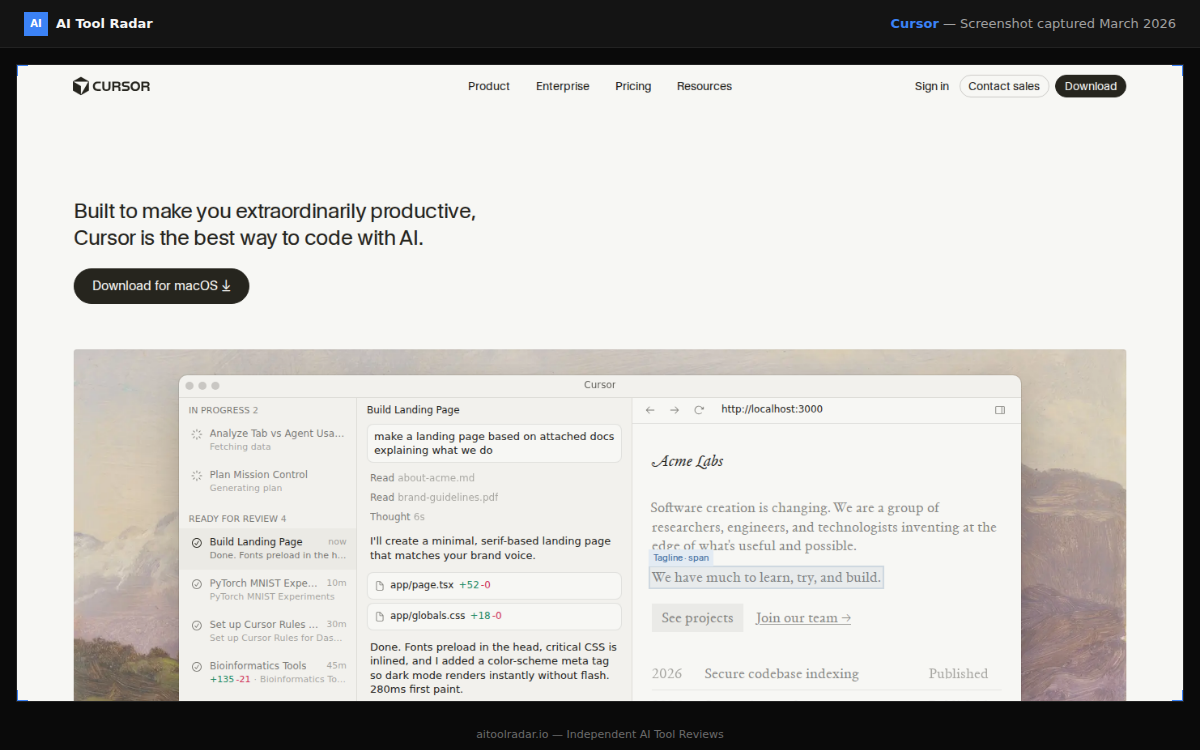
Cursor Pro (20 $/mo)
- Advertised: "includes premium model usage"
- Actual usage: 20 $ covers roughly 500-700 premium requests per month
- Overage: additional premium requests at standard API rates, stacks fast if you use Opus 4.6 heavily
- Real monthly cost: 28-55 $ in active development months
- Verdict: the advertised 20 $ is genuinely misleading for anyone who codes daily. Pro+ at 60 $ is often the practical plan. See the Cursor guide for details.
ElevenLabs Creator (22 $/mo)
- Advertised: 100.000 characters per month
- Actual usage: my own content consumes 60-90k, client work can exceed the budget
- Overage: additional characters at 0,3 $ per 1k characters
- Real monthly cost: 22-45 $
- Verdict: the included 100k characters is enough for a one-person workflow, but breaks fast for any team use
Canva Pro (12,99 $/mo)
- Advertised: includes "Magic Studio AI features"
- Actual usage: daily use, generating images and using Magic Edit
- Overage: soft rate limits kick in mid-month, but never hard charges
- Real monthly cost: 12,99 $
- Verdict: genuine flat rate, no credit surprises. See the Canva AI guide.
OpenAI API (pay as you go)
- Advertised: pay per token, clear rates per model
- Actual usage: varies wildly by project
- Overage: N/A, pay what you use
- Real monthly cost: 15-120 $ depending on projects
- Verdict: most honest model, but requires discipline on your end
The patterns that hurt people#
Looking across those numbers, three patterns cause most of the sticker shock.
Pattern 1: The first-month euphoria#
You subscribe, the first few days are magic, you generate hundreds of images, edit dozens of clips, and then realise on day eight that your entire monthly credit budget is gone.
The advertised price assumed you would spread usage across the month. You did not. Nobody does on day one.
Fix: in the first week, deliberately cap yourself at 25 percent of the monthly credit budget. Save the rest for the real work once the novelty fades.
Pattern 2: The "just one more generation" trap#
Credit-based tools make each individual generation feel trivially cheap. Two credits for this image, six for that video clip, nothing for a quick prompt rewrite. None of it feels expensive in the moment.
Then the invoice arrives.
Fix: calculate your per-credit cost upfront. If Midjourney gives you 200 fast generations for 10 $, that is 0,05 $ per image. Knowing that changes your generation behavior more than any warning in the UI.
Pattern 3: The feature gate disguised as a plan#
The plan above yours has the feature you actually want. Runway's motion brush, ElevenLabs' voice cloning, Cursor's higher model quota. Subscribing to the lower plan and hitting the feature gate repeatedly is worse than just upgrading.
Fix: if you hit a feature paywall in the first week, upgrade. The "I will work around it" path almost always costs more in your time than the extra subscription cost.
How to budget honestly#
If you are building an AI tool stack for real work, the advertised prices are the starting point, not the actual cost.
My rule of thumb after two years of this:
- Flat rate tools: budget at the advertised price
- Credit-based with clear exchange rates: budget at 150 percent of the advertised price
- Credit-based with fuzzy exchange rates: budget at 200 percent of the advertised price
For my current stack (Claude, ChatGPT, Cursor, Midjourney, ElevenLabs, Canva, OpenAI API), the advertised total is 130 $/month. The actual monthly average over the last six months is 215 $. That is a 65 percent markup over the headline numbers.
What I actually recommend#
A few concrete decisions I made after watching the bills:
-
For anything I use daily, I go straight to the second-highest tier. The jump from Pro to Pro+ on Cursor eliminated the "am I going to hit the limit today" anxiety, which was worth more than the 40 $ delta.
-
For anything with very unpredictable usage (Runway, OpenAI API), I set hard spend caps where the tool offers them. Runway has a cap, OpenAI lets you set one per API key, Cursor does not. I avoid running tools with no cap for heavy production work.
-
For everything else, I keep a spreadsheet. Monthly review of actual vs advertised costs. Tools that consistently bill at 200 percent of advertised get kicked out unless the value is obvious.
The broader point#
Credit-based pricing is not a scam. It is a rational response to the underlying economics of generative AI, where actual compute costs vary enormously per request. Flat rate pricing has to either overprice the average user to subsidize the power user (Claude Pro for a light user is a bad deal) or rate-limit aggressively.
But understanding the pattern matters. The headline price is a marketing number. The real price is visible only after you have been billing for three months. Plan accordingly, and the tools are still worth it. Plan naively, and every invoice feels like a betrayal.