
This site contains affiliate links. We may earn a commission at no extra cost to you. This helps us keep the site running and continue providing free guides and comparisons.
The Bottom Line#
RunPod is the price-performance benchmark for renting GPUs in 2026. An RTX 4090 costs $0.69/hour, an A100 starts at $1.39/hour, an H100 at $2.89/hour, all billed per second, with zero egress fees where hyperscalers charge $0.09-0.12/GB on the way out. Serverless endpoints with sub-200ms FlashBoot cold starts make it one of the few platforms where scale-to-zero inference actually works. The catch is reliability variance: Trustpilot sits at 3.5/5, with recurring reports of pods that fail to start while billing continues, and storage billing quirks that catch newcomers off guard. For disposable experiments, fine-tuning runs, and cost-sensitive inference, RunPod is excellent. For workloads that must stay up around the clock, plan defensively or pay more elsewhere.
Rating: 4.1/5 | Price: from $0.27/hour, pay-as-you-go | Last verified: July 2026
Score Breakdown
Key Facts#
- Pricing: Pods from $0.27/hr (RTX A5000) to $7.39/hr (B300); RTX 4090 $0.69/hr, A100 from $1.39/hr, H100 from $2.89/hr, H200 $4.39/hr; billed per second
- Serverless: H100 $4.55/hr, A100 $2.72/hr, RTX 4090 $1.10/hr while active; scale-to-zero with FlashBoot cold starts under 200ms
- Free tier: No free tier; pay-as-you-go with no subscription or minimum commitment
- Storage: Network volumes $0.07/GB/mo (first TB, then $0.05), container disk $0.10/GB/mo, idle volume disk $0.20/GB/mo
- Egress: Zero ingress/egress fees
- Key differentiator: Per-second billing across roughly 20 GPU types, plus the cheaper Community Cloud tier for non-critical workloads
- Guardrail: Default account spend cap of $80/hr
- Company: Founded 2022, claims 750,000+ developers; used by teams at Hugging Face, Perplexity, and Cursor
What Is RunPod and Who Is It For?#
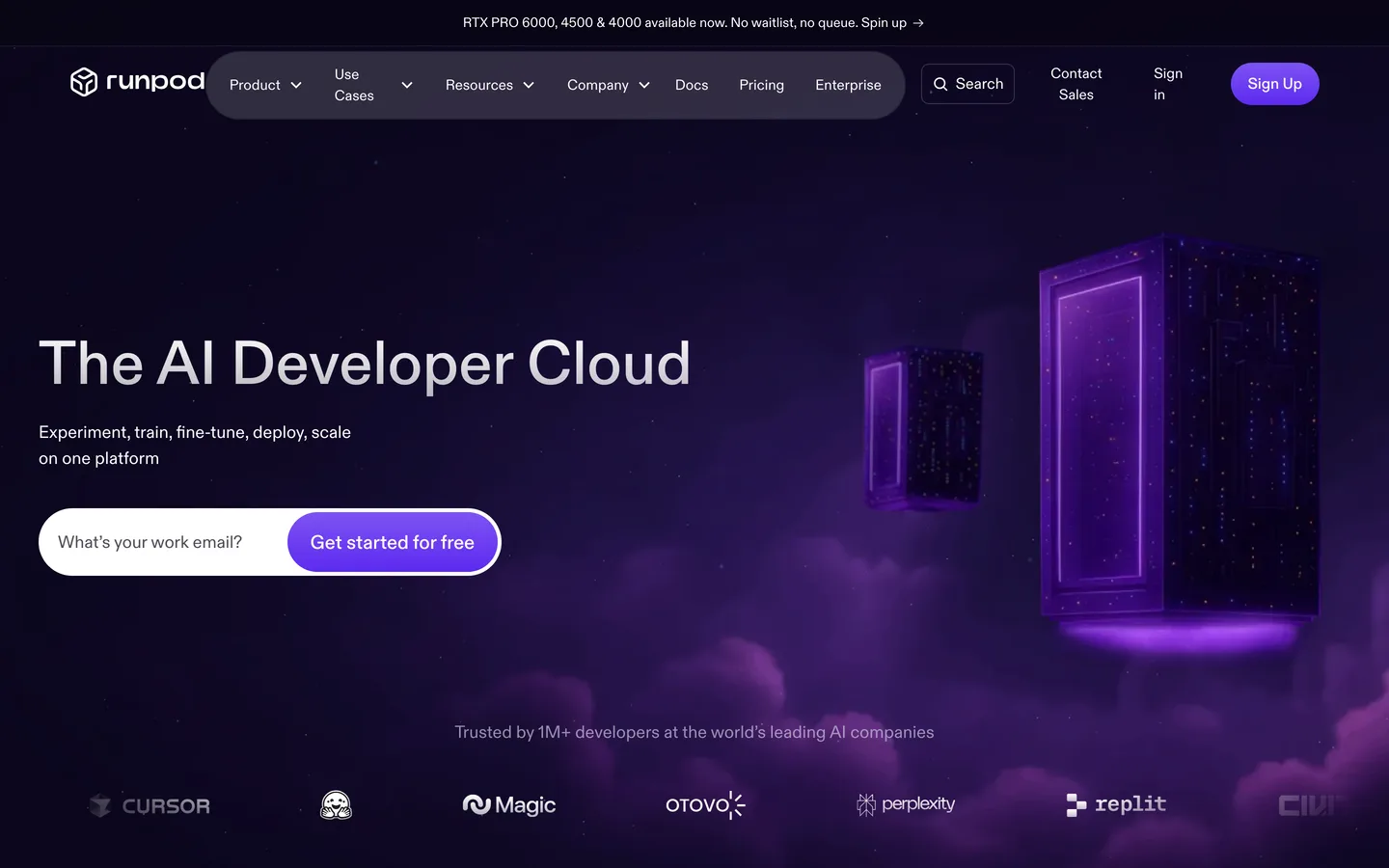
RunPod is a GPU cloud built for AI workloads: training, fine-tuning, and inference. Instead of reserving instances by the month, you spin up a pod (a container with attached GPUs) and pay by the second until you kill it. On top of pods sit serverless endpoints that scale to zero between requests, and Instant Clusters for multi-node training jobs that would normally require a sales conversation at a bigger cloud.
The audience is developers and small teams who feel hyperscaler pricing in their bones: indie hackers fine-tuning open-source models, startups running inference APIs without platform-engineering headcount, researchers who need an H100 for an afternoon, and hobbyists running image-generation workloads on consumer cards. If your workload fits in one GPU and tolerates the occasional restart, RunPod's economics are hard to argue with.
Capacity comes in two flavors. Secure Cloud runs in data centers with enterprise-grade reliability. Community Cloud is peer-provided capacity at lower rates with fewer guarantees, fine for experiments, risky for production.
How We Built This Guide#
This guide is based on RunPod's official pricing page and documentation, verified pricing as of July 2026, aggregated user feedback from Trustpilot and G2, an independent hands-on review with 15 community ratings, and third-party pricing comparisons. We did not run a paid benchmark suite ourselves for this guide.
Our sources include:
- Official pricing page and serverless pricing docs
- Trustpilot reviews (231 reviews, 3.5/5 at time of writing)
- Independent hands-on testing (Hack'celeration, 5-criteria review)
- Third-party pricing comparisons (Thunder Compute, Spheron)
- RunPod referral and billing documentation
Why RunPod
Visit provider- On-Demand PodsPods are the core product: pick a GPU, a template, and a region, and you have a running container with SSH and Jupyter access in a few minutes.
- Serverless with FlashBoot
- Instant ClustersMulti-node training normally means capacity planning and a sales call.
- Hub Templates and GitHub Deployments
- Storage, Networking, and the Billing ModelStorage is where new users get surprised, so here are the numbers plainly.
Features in Depth#
On-Demand Pods#
Pods are the core product: pick a GPU, a template, and a region, and you have a running container with SSH and Jupyter access in a few minutes. The GPU list spans roughly 20 types, from the $0.27/hr RTX A5000 through the $0.69/hr RTX 4090 up to H100 ($2.89-3.19/hr), H200 ($4.39/hr), B200 ($5.89/hr), and B300 ($7.39/hr). Per-second billing means a 40-minute fine-tuning run costs 40 minutes, not a full hour. The default $80/hr spend cap prevents a scripting mistake from becoming a four-figure invoice.
The Secure/Community split matters more than the marketing suggests. Community Cloud is noticeably cheaper, but user reviews consistently report more variance there: pods with old drivers, instances that fail mid-job, and GPUs shown as available that are not. Treat Community Cloud as spot-like capacity and checkpoint accordingly.
Serverless with FlashBoot#
Serverless endpoints autoscale workers between zero and your configured maximum, billed per second while active: H100 at $4.55/hr, A100 at $2.72/hr, RTX 4090 at $1.10/hr, down to $0.58/hr for A4000-class cards. The differentiator is FlashBoot, which benchmarks cold starts under 200ms, fast enough that scale-to-zero becomes viable for user-facing inference instead of just batch jobs. If your traffic is spiky, this is where RunPod's economics beat reserved instances decisively: you pay $0 between requests.
Note the premium: serverless H100 time costs $4.55/hr against $2.89/hr for the same card as a pod. You are paying for the autoscaling and the idle time you no longer burn. Do the math for your duty cycle; above roughly 60% sustained utilization, a plain pod is cheaper.
Instant Clusters#
Multi-node training normally means capacity planning and a sales call. RunPod's Instant Clusters provision multi-node setups on demand, with H200 SXM at $4.31/hr and A100 SXM at $1.79/hr per GPU; larger configurations (H100 SXM, B200) go through sales. For teams that occasionally need distributed training without committing to reserved capacity, this fills a real gap between "one big pod" and "sign an annual contract."
Hub Templates and GitHub Deployments#
The Hub offers one-click templates for popular open-source models and tooling, so a working environment is a template click rather than a Dockerfile session. For custom workloads, native GitHub integration deploys from a repository with rollback support, which makes the path from "works locally" to "runs on an H100" genuinely short. Community documentation is a repeated bright spot in reviews; most common workflows have a written guide or a template.
Storage, Networking, and the Billing Model#
Storage is where new users get surprised, so here are the numbers plainly. Network volumes (persistent, attachable) cost $0.07/GB/mo for the first TB, $0.05 beyond, $0.14 for the high-performance tier. Container disks cost $0.10/GB/mo while a pod exists. The trap: a stopped pod keeps its volume disk, billed at $0.20/GB/mo, double the running rate. Multiple reviewers report low-balance warnings from pods they thought were "off." If you are done, delete the pod, not just stop it; keep anything worth keeping on a network volume.
The good news on networking: ingress and egress are free. Moving a 50GB dataset in and trained weights out costs nothing, where the same round trip on a hyperscaler runs real money.
Pros
- Among the cheapest rates anywhere for H100s and RTX 4090s, billed per second instead of per hour
- Zero egress fees, against $0.09-0.12/GB at hyperscalers, which matters for dataset-heavy work
- FlashBoot cold starts under 200ms make scale-to-zero serverless inference genuinely usable
- Roughly 20 GPU types from consumer cards to B300, plus Instant Clusters without a sales call
- Pay-as-you-go with no subscription; a pod is live within minutes, with an $80/hr default spend cap
- Free ingress/egress and readable documentation praised across reviews
Cons
- Trustpilot 3.5/5 with recurring reports of pods failing to start or crashing while billing continues
- Stopped pods bill storage at $0.20/GB/mo, double the running rate, a documented surprise for newcomers
- GPU availability fluctuates at peak times; the dashboard has shown unavailable GPUs as available
- Community Cloud reliability varies (old drivers, mid-job failures); no SLA on standard plans
- Support quality is uneven: some report fast help, others slow follow-up on billing disputes
- Spot pricing has been changed abruptly in the past (raised 25%, removed, re-gated behind the API)
Pricing Breakdown#
RunPod has no plans or subscriptions; everything is pay-as-you-go, billed per second, as of July 2026.
Pods (Secure Cloud) -- On-demand GPU containers. Budget cards start at $0.27/hr (RTX A5000) and $0.39/hr (L4); the workhorse RTX 4090 costs $0.69/hr; 48GB cards run $0.44-0.99/hr (A40 to L40S); data-center cards go from $1.39/hr (A100 PCIe) through $2.89-3.19/hr (H100 variants) to $4.39/hr (H200), $5.89/hr (B200), and $7.39/hr (B300).
Community Cloud -- The same pod model on peer-provided hardware at lower rates. Good for experiments and interruptible jobs; reviews report more variance in drivers, stability, and availability.
Serverless -- Autoscaling endpoints billed per second of active execution: $0.58/hr (A4000/A4500), $0.69/hr (L4/A5000), $1.10/hr (RTX 4090), $2.72/hr (A100), $4.55/hr (H100), $5.93/hr (H200), up to $9.98/hr (B300). Scale-to-zero means idle time costs nothing.
Instant Clusters -- Multi-node training: A100 SXM $1.79/hr, H200 SXM $4.31/hr per GPU; H100 SXM and B200 via sales.
| Offering | Price | Best For |
|---|---|---|
| ⭐ Pods | $0.27-7.39/hr | Training, fine-tuning, interactive work |
| Community Cloud | Below Secure rates | Interruptible experiments |
| Serverless | $0.58-9.98/hr active | Spiky inference, scale-to-zero APIs |
| Instant Clusters | from $1.79/hr/GPU | Multi-node distributed training |
The number to watch is storage, not compute. Network volumes at $0.07/GB/mo are cheap, but container and volume disks on forgotten pods add up, and a stopped pod bills its volume at $0.20/GB/mo. Delete pods you are done with, keep durable data on network volumes, and set the spend cap below the $80/hr default if your usage is occasional.
Pods (Secure Cloud)
- RTX A5000 $0.27/hr, RTX 4090 $0.69/hr
- A100 from $1.39/hr, H100 from $2.89/hr
- Per-second billing
- Community Cloud capacity at lower rates
Serverless
- FlashBoot cold starts under 200ms
- Scale-to-zero, pay only while running
- H100 $4.55/hr, A100 $2.72/hr
- RTX 4090 $1.10/hr
Storage
- Network volumes $0.07/GB (first TB)
- Container disk $0.10/GB/mo
- Idle volume disk $0.20/GB/mo
- Zero ingress/egress fees
Similar Tools Worth Considering#
- Vast.ai: Marketplace model with the lowest absolute prices for consumer GPUs, but even more variance than Community Cloud. The budget option when reliability barely matters.
- Lambda: Data-center H100/B200 capacity with a reserved-first model. Better for sustained training; weaker for short bursts and serverless.
- Modal: Python-native serverless compute with excellent developer experience. Better abstractions, higher per-hour rates; you trade control for convenience.
- Together AI: Managed inference and fine-tuning API for open-source models. The right choice when you want tokens, not GPUs.
- Hyperscalers (AWS/GCP/Azure): Win on compliance, SLAs, and ecosystem integration; lose badly on price and egress for pure GPU workloads.
If you are deciding whether to rent GPUs at all or run models locally, our breakdown of open-source AI in 2026 covers the hardware math. For a broader overview, see our Best AI Tools 2026 guide.
Who Should Use RunPod?#
Best for indie developers and researchers: An H100 for an afternoon of fine-tuning costs less than $12. Per-second billing plus templates means minimal setup tax on short experiments.
Best for startups running inference APIs: Serverless with FlashBoot handles spiky traffic with scale-to-zero economics that reserved instances cannot match below sustained load.
Best for open-source model workloads: Free egress and one-click templates make the download-weights, fine-tune, ship-weights loop cheap and fast.
NOT for you if you need contractual SLAs and guaranteed uptime for production (no SLA on standard plans), your compliance requirements mandate specific certifications and data residency guarantees, or you want a fully managed API where someone else operates the model (look at Together AI or a hosted provider instead).
Final Verdict#
RunPod wins on economics and loses on predictability. The pricing is genuinely best-in-class: per-second billing, free egress, and H100s at $2.89/hr create a cost structure that hyperscalers cannot approach, and FlashBoot makes serverless GPU inference practical instead of theoretical. That is why 750,000+ developers use it, and why it is the default recommendation for experiments, fine-tuning, and cost-sensitive inference.
The 3.5/5 on Trustpilot is equally real. Pods that fail while billing runs, storage charges from stopped pods, and peak-time availability gaps are recurring themes, not isolated incidents. The pattern in reviews is consistent: RunPod is excellent for disposable workloads and risky for anything that must not go down. Checkpoint your training runs, delete pods instead of stopping them, watch the first invoice, and RunPod will likely be the cheapest serious GPU compute you can buy in 2026.
FAQ#
How much does RunPod cost?#
There is no subscription; you pay per second for what you use. Pods range from $0.27/hr (RTX A5000) to $7.39/hr (B300), with the popular RTX 4090 at $0.69/hr and H100 from $2.89/hr. Serverless runs $0.58-9.98/hr while active. Storage costs $0.05-0.14/GB/mo depending on type, and egress is free.
Does RunPod have a free tier?#
No. RunPod is pay-as-you-go: you load credits and spend them per second of compute. There is no monthly free allotment, but there is also no minimum commitment, so a small experiment costs cents.
What is the difference between Secure Cloud and Community Cloud?#
Secure Cloud runs in data centers with enterprise-grade reliability and is the default for anything that matters. Community Cloud is peer-provided capacity at lower prices with fewer guarantees; reviews report more variance in drivers, stability, and availability. Use it for interruptible, checkpointed workloads.
Is RunPod serverless fast enough for real-time inference?#
With FlashBoot, cold starts benchmark under 200ms, which makes scale-to-zero viable for user-facing APIs, not just batch processing. Sustained high-traffic endpoints should compare serverless rates ($4.55/hr for H100) against a plain pod ($2.89/hr): above roughly 60% utilization the pod wins.
Why did RunPod charge me after I stopped my pod?#
Stopping a pod keeps its volume disk, billed at $0.20/GB/mo, double the running rate. This is the most common billing surprise in user reviews. If you are done with a pod, delete it entirely and keep durable data on a network volume ($0.07/GB/mo), which survives pod deletion.