This site contains affiliate links. We may earn a commission at no extra cost to you. This helps us keep the site running and continue providing free guides and comparisons.
The Bottom Line#
bunny.net is the delivery layer you bolt onto a project that already exists. It moves bytes, stores files, runs containers and serves fonts, all billed by usage with a $1 monthly minimum and no free tier at all.
It is not a Vercel or Netlify replacement. There is no git-push deployment, no preview per branch, no bundled auth or database-with-API. What it does instead is take the expensive parts of delivery off your existing host at roughly a tenth of hyperscaler pricing.
Buy it if egress and storage are what hurt. Skip it if what you actually want is a place to deploy.
Key Facts#
- CDN: from $0.01/GB across 119 PoPs, or $0.005/GB on the 10-PoP volume network
- Edge Storage: from $0.01/GB per region, no per-request and no API egress charges
- Magic Containers: $0.02 per CPU core/hour, $0.005 per GB RAM/hour, 41 regions
- Bunny Fonts: free, no account, Google Fonts API-compatible
- Free tier: none. $1 monthly minimum applies
- Rating: 4.8/5 from 479 reviews on G2
- Based: built and hosted in Europe
Prices as of August 3, 2026. Check bunny.net/pricing for current rates.
What Is bunny.net and Who Is It For?#
bunny.net sells infrastructure primitives individually. You can take only the CDN and ignore everything else, or use the free font service without ever opening a paid account for the rest.
That separability is the point. Most competitors want you inside their ecosystem; bunny.net is comfortable being one line in your build.
It fits three groups. Solo developers and small agencies shipping side projects where a $200 cloud bill would kill the project. Media-heavy sites where egress dominates the invoice. And European businesses that would rather keep delivery inside the EU for GDPR reasons.
It does not fit teams who want a platform. If your mental model is "push to main and it deploys," this is the wrong tool.
How We Built This Guide#
Prices come from the vendor's public pricing pages, checked on August 3, 2026. Product capabilities come from the same source. The weaknesses in the cons section come from a published year-long production review rather than from marketing material, and the rating reflects 479 verified G2 reviews.
We have not settled a bill on this account ourselves, so the example costs below are arithmetic on published rates, not invoices.
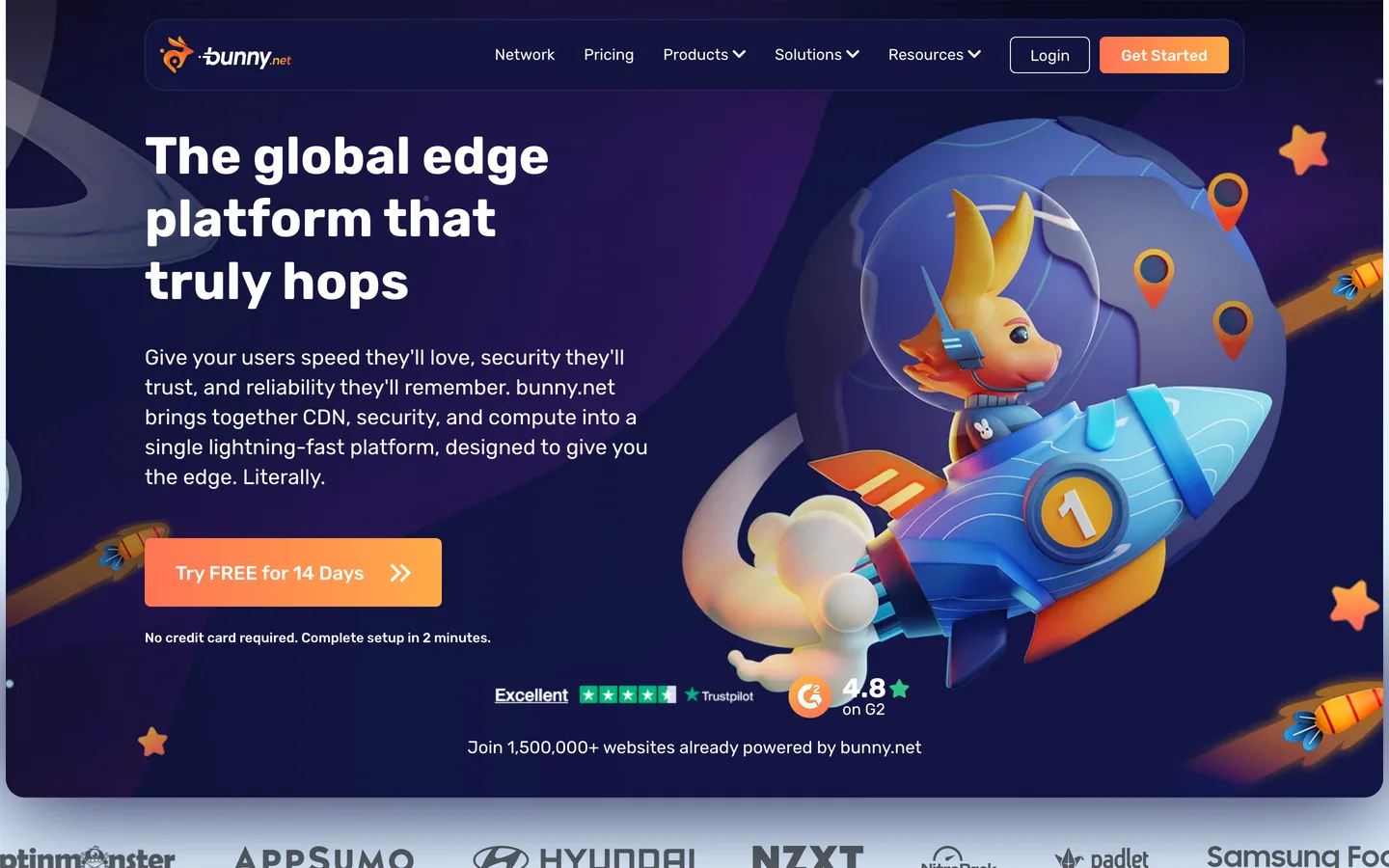
Why bunny.net
Visit provider- CDN: two networks, different tradeoffs
- Edge Storage: the fee structure matters more than the rateStandard tier runs on HDD at $0.01/GB per region for up to two regions, $0.005/GB for each additional region, up to nine replication regions.
- Magic Containers: Docker without orchestration
- Bunny Fonts: free, and the reason many people arriveA Google Fonts API-compatible service: swap the CSS import or link tag and you are done.
- The rest
Features in Depth#
CDN: two networks, different tradeoffs#
The Standard Network spans 119 points of presence and prices by region: $0.01/GB in Europe and North America, $0.03/GB in Asia and Oceania, $0.045/GB in South America, $0.06/GB in the Middle East and Africa.
The Volume Network is half the entry price at $0.005/GB for the first 500 TB, tiering to $0.004/GB up to 1 PB and $0.002/GB above that. The catch is ten PoPs instead of 119. For large downloads it is excellent. For an interactive app with a global audience the latency difference is real.
Most projects should start on Standard and only look at Volume once file sizes dominate the bill.
Edge Storage: the fee structure matters more than the rate#
Standard tier runs on HDD at $0.01/GB per region for up to two regions, $0.005/GB for each additional region, up to nine replication regions. The Edge tier runs on SSD at $0.02/GB per region across up to 15 regions.
The rate is competitive but not remarkable. What is remarkable is what is absent: no per-request charges, no API egress charges, and free traffic from Edge Storage into the Bunny CDN.
Anyone who has taken apart an S3 invoice knows the storage line is rarely the problem. It is the GET requests and the egress that surprise. Removing both changes the arithmetic more than a lower per-GB rate would.
Magic Containers: Docker without orchestration#
Containers run across 41 regions at $0.02 per CPU core/hour and $0.005 per GB RAM/hour, plus $0.10/GB per month for storage and $0.01 to $0.06/GB egress depending on region.
A continuously running container with one core and one GB of RAM works out to roughly $18/month. Multiple containers can run together as one app with shared storage, and volumes attach per region automatically.
This is the youngest product in the lineup and the one to be most careful with. It is less proven than AWS ECS or Fly.io for production workloads.
Bunny Fonts: free, and the reason many people arrive#
A Google Fonts API-compatible service: swap the CSS import or link tag and you are done. No account, permanently free, built and hosted in Europe, and per the vendor with no logging, no cookies and no third-party sharing.
The practical value is legal rather than technical. Embedding Google Fonts sends every visitor's IP to Google on every page load, which is what drove the German warning-letter waves. This removes that in one find-and-replace, and it is worth doing even if you never become a paying customer.
The rest#
Bunny Stream handles video delivery, Bunny Shield is the WAF, Edge Scripting runs code at the edge, Bunny DNS handles routing, and Bunny Database offers SQLite-compatible storage. We have not tested these and do not rate them here.
Pricing Breakdown#
Three worked examples on published rates:
Static site, European audience, 100 GB delivered per month. CDN Standard at $0.01/GB means $1. Bunny Fonts is free. Total: the $1 minimum.
App with uploads, 50 GB stored in one region, 500 GB delivered. Storage $0.50, delivery $5. Traffic from storage into the CDN is free, so nothing is double-charged. Total: around $5.50.
Small backend, one always-on container, 200 GB egress. Compute roughly $18, egress $2 at European rates, plus storage. Total: around $21.
The $1 monthly minimum means a genuinely idle project costs a dollar, not zero. There is no free tier to fall back to.
| Plan | Price | Key Features |
|---|---|---|
| CDN Volume | $0.005/GB | 10 PoPs worldwide, First 500 TB at this rate, Down to $0.002/GB above 1 PB, Best for large files |
| ⭐ CDN Standard | $0.01/GB | 119 PoPs worldwide, Europe and North America rate, $0.03/GB Asia and Oceania, $0.06/GB Middle East and Africa |
| Edge Storage | $0.01/GB | Per region, HDD tier, $0.02/GB SSD tier, No request or API egress fees, Free traffic into Bunny CDN |
Pros and Cons#
Pros
- Roughly an order of magnitude cheaper than hyperscalers for egress-heavy delivery
- No per-request or API egress fees, the line items that make an S3 bill unpredictable
- Bunny Fonts solves the Google Fonts GDPR problem for free in one find-and-replace
- Products are separable, so you can adopt one piece without committing to a platform
- Built and hosted in Europe, which shortens the GDPR paperwork for EU businesses
Cons
- No free tier at all, where Cloudflare gives hobbyists a generous one
- 119 PoPs against Cloudflare's 300-plus, with weaker Asia-Pacific results (30 to 60 ms depending on location)
- Average latency around 24 ms versus 15 to 20 ms typical for Cloudflare
- Magic Containers is young and less proven than AWS ECS or Fly.io for production
- No built-in web analytics, so you bring your own
- The WAF interface is basic next to Cloudflare's
- Bunny Optimizer costs $9.50/month per website, which adds up across several properties
Rating Breakdown#
Value for money carries this score. On price per delivered GB there is very little that competes, and the absence of request and egress fees matters more than the headline rate.
Features lose points for the gaps rather than the quality: no analytics, a basic WAF, and no application-hosting conveniences. Performance is good but measurably behind Cloudflare, particularly in Asia-Pacific. Ease of use is solid for anyone comfortable with infrastructure and poor for anyone expecting a deploy button.
Use Cases#
Taking delivery off an expensive host. You deploy on Vercel or a VPS and the egress line is the problem. Point assets at Bunny CDN and leave deployment where it is. This is the strongest case.
Media-heavy projects. Image galleries, downloads, audio and course material, where the bill is dominated by bytes out rather than compute.
GDPR-sensitive European sites. European hosting plus Bunny Fonts removes two recurring items from a data protection review.
Side projects that must stay cheap. A static site with a CDN in front realistically costs the $1 minimum, provided you accept there is no free tier.
Alternatives#
Cloudflare has a real free tier, more than 300 PoPs, better latency and a far more capable WAF. It is the default recommendation unless price or European hosting is the deciding factor.
Amazon S3 with CloudFront wins on ecosystem depth and loses badly on egress and request pricing. Choose it when you are already inside AWS.
RunPod solves a different problem, GPU compute rather than delivery, but shows up in the same conversations because both compete on being cheaper than hyperscalers with per-second or per-usage billing.
Verdict#
bunny.net earns its place when the invoice, not the developer experience, is what hurts. The pricing is honest, the absence of request and egress fees is worth more than it looks, and Bunny Fonts is free value that any European site should take regardless.
Its biggest strength is cost per delivered gigabyte. Its biggest weakness is that it is infrastructure and nothing more: no free tier to experiment on, no deployment workflow, and a container product still proving itself. Pair it with a host you already like rather than expecting it to replace one.
FAQ#
Is bunny.net cheaper than Cloudflare?#
For paid usage, generally yes, often substantially. But Cloudflare has a free tier and bunny.net has none, so for a small hobby project Cloudflare can be cheaper by being free. The comparison flips as soon as you are paying either way.
Does bunny.net have a free plan?#
No. There is a $1 monthly minimum and billing is by actual usage. Bunny Fonts is the one exception: permanently free and usable without an account.
Is bunny.net GDPR compliant?#
It is built and hosted in Europe, which simplifies matters, and Bunny Fonts is explicitly a privacy-focused alternative to Google Fonts. Compliance still depends on your own processing and documentation; hosting location alone does not make a site compliant.
Can I host my whole application on bunny.net?#
Partly. Magic Containers runs Docker workloads across 41 regions, so an API or backend can live there. But there is no git-push deployment, no branch previews and no bundled auth or managed database with an API layer, so most teams pair it with a separate host.
How does Bunny Fonts differ from Google Fonts?#
It exposes a compatible API, so migration is swapping the import. The difference is that visitor IP addresses do not go to Google, which is the point for European sites.