
This site contains affiliate links. We may earn a commission at no extra cost to you. This helps us keep the site running and continue providing free guides and comparisons.
The Bottom Line#
Dify is an open-source platform for building production LLM applications: agents, RAG-powered chatbots, and multi-step AI workflows, all through a visual builder with a built-in knowledge base and strong observability. With 147k+ GitHub stars it is one of the most popular open-source AI builders, and its biggest advantage is control: you can self-host the Community Edition for free on your own infrastructure and keep every byte of data in-house. There is also Dify Cloud, a managed SaaS from a free Sandbox up to Professional ($59/workspace/month) and Team ($159), for teams who want to skip the setup. The most important thing for EU teams to know: Dify Cloud does not guarantee EU data residency (its privacy policy lists China and the US among processing locations), so if you have GDPR obligations, self-hosting on your own EU infrastructure is the clean path. For developers and technical teams who want a batteries-included, self-hostable AI builder, Dify is one of the best options in 2026.
Rating: 4.4/5 | Price: Free (self-host) / Cloud from $59/month | Last verified: July 2026
Score Breakdown
Key Facts#
- Pricing: Self-host Community Edition (free), Dify Cloud Sandbox (free), Professional ($59/workspace/mo), Team ($159), Enterprise (custom)
- Open source: Yes, 147k+ GitHub stars; license is Apache 2.0 base with two conditions (no multi-tenant SaaS resale, no logo removal)
- Self-hostable: Docker Compose, Kubernetes Helm, Terraform, AWS CDK
- Company: LangGenius, Inc. (US-registered, China-origin team); founded 2023
- EU note: Dify Cloud has no EU data-residency guarantee; self-host for GDPR
- German UI: Yes (de-DE supported)
What Is Dify and Who Is It For?#
Dify is an LLMOps platform: a place to design, ship, and monitor AI applications without wiring everything together yourself. Its visual, node-based builder lets you compose agentic workflows; a built-in knowledge base handles RAG (document ingestion, retrieval, and vector storage) out of the box; and it supports a broad set of models (OpenAI, Anthropic, Azure, Llama, Hugging Face, and local models). You can expose any app as a backend API or as an MCP server, and the observability tools show per-node timing and clear errors, which makes debugging real applications far easier than in a raw framework.
It is built for developers and technical product teams who want to ship LLM apps, chatbots, and agents quickly, and for organizations that need a self-hostable platform for data control. The no-code builder means non-developers can assemble simple apps, but the full feature set has a genuine learning curve, so the sweet spot is technical teams. If you want a hosted consumer chatbot with zero setup, this is more of a builder than a finished product.
How We Built This Guide#
This guide is based on Dify's official site and pricing page, its privacy policy, the public GitHub repository (147k+ stars, verified via the GitHub API), and independent reviews on G2. We verified the open-source/self-host versus Dify Cloud split, the current Cloud tiers, and the German-UI support (confirmed in the live repository). The EU data-residency point comes directly from Dify's privacy policy, which lists China and the US among processing locations. Where funding or valuation figures came only from aggregators, we flag them rather than state them as fact. All facts were last verified July 2026.
Our sources include:
- Dify official site, pricing and privacy pages
- The public GitHub repository and license
- G2 user reviews and community discussions
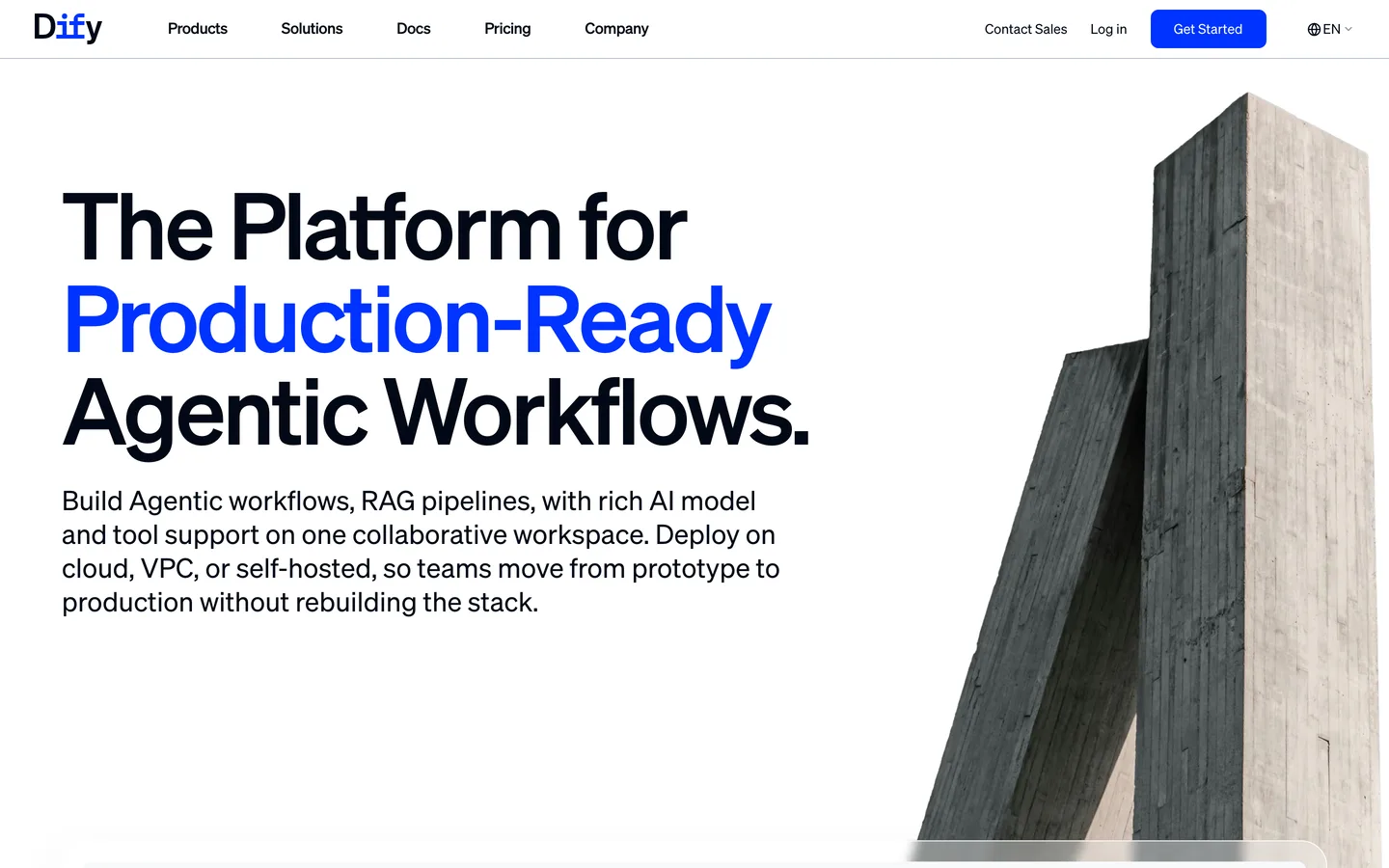
Why Dify
Visit provider- Visual Agentic Workflow Builder
- Built-in RAG Knowledge BaseDify ships with a knowledge base that handles the whole RAG pipeline: ingest documents, index them, and retrieve relevant chunks at query time.
- Broad Model Support and MCPDify supports OpenAI, Anthropic, Azure OpenAI, Llama, Hugging Face, Replicate, and local models, so you are not locked to one provider.
- Prompt IDE, App-as-API, and ObservabilityA prompt IDE helps you iterate on prompts, and any flow can be exposed as a backend API.
- Self-Hosting and DeploymentYou can deploy Dify via Docker Compose, Kubernetes Helm, Terraform, or AWS CDK.
Features in Depth#
Visual Agentic Workflow Builder#
The core of Dify is a drag-and-drop, node-based builder for composing AI workflows: prompts, model calls, logic, tools, and agents chained into an application. It is powerful enough for production apps while remaining visual.
Built-in RAG Knowledge Base#
Dify ships with a knowledge base that handles the whole RAG pipeline: ingest documents, index them, and retrieve relevant chunks at query time. Having this integrated rather than bolted on is one of the biggest reasons teams choose Dify over a raw framework.
Broad Model Support and MCP#
Dify supports OpenAI, Anthropic, Azure OpenAI, Llama, Hugging Face, Replicate, and local models, so you are not locked to one provider. It has native MCP integration and can publish your apps as MCP servers, fitting into the wider agent ecosystem.
Prompt IDE, App-as-API, and Observability#
A prompt IDE helps you iterate on prompts, and any flow can be exposed as a backend API. The observability layer (per-node duration, inputs/outputs, clear errors, plus Langfuse integration) is frequently praised as best-in-class for debugging real LLM apps.
Self-Hosting and Deployment#
You can deploy Dify via Docker Compose, Kubernetes Helm, Terraform, or AWS CDK. Self-hosting the Community Edition is free and keeps all data on your own infrastructure, which is the key to using Dify in a GDPR-compliant way.
The License and EU Nuance#
Dify is open source but not unconditionally: its license is Apache 2.0 with two conditions, no reselling Dify as a multi-tenant SaaS without a commercial license, and no removing the Dify logo. For most self-hosted internal use this is a non-issue. The bigger nuance is data residency, covered below.
Pros
- Genuinely open-source and self-hostable, giving full control over data and infrastructure
- Batteries-included: visual workflow builder plus an integrated RAG knowledge base out of the box
- Best-in-class debugging and observability (per-node timing, clear errors)
- Very broad model support (OpenAI, Anthropic, Azure, Llama, Hugging Face, local) avoids lock-in
- Large, active community with 147k+ GitHub stars and frequent updates
- Fast time to a working app compared with assembling a raw framework
Cons
- Real learning curve; the feature set can feel overwhelming for newcomers
- Dify Cloud has no EU data-residency guarantee (its policy lists China and the US as processing locations)
- The license is not pure open source: no multi-tenant SaaS resale, no logo removal without a commercial license
- Self-hosting is genuine infrastructure work (compute, storage, maintenance)
- Enterprise pricing is opaque (contact-sales only), and the Community/Premium/Enterprise split can confuse
Features (4.6): Workflow builder, RAG, agents, broad model support, MCP, and app-as-API make it one of the most complete open-source AI builders available.
RAG & Knowledge (4.5): The integrated knowledge base is a genuine strength and a common reason teams pick Dify over a framework.
Data Control (4.6): Self-hosting the open-source edition gives complete control over where data lives, which is the whole point for regulated teams.
Ease of Use (3.8): Powerful but not beginner-friendly. The visual builder helps, but the full feature set takes time to learn.
EU Compliance (3.6): Self-hosting is fully EU-compliant, but Dify Cloud is not, since it lists China and the US as processing locations. The score reflects that Cloud users must self-host for GDPR.
Pricing Breakdown#
| Plan | Price | Key Features |
|---|---|---|
| ⭐ Community (Self-host) | $0 | Open source, full data control, you manage infra |
| Sandbox (Cloud) | $0 | 200 message credits, 1 workspace, 5 apps |
| Professional (Cloud) | $59/workspace/mo | 5,000 credits/mo, 3 members, 50 apps |
| Team (Cloud) | $159/workspace/mo | 10,000 credits/mo, 50 members, 200 apps |
| Enterprise | Custom | Contact sales; free for students/educators |
Dify splits into two paths:
Open source / self-hosted (free) -- run the Community Edition on your own infrastructure (minimum 2 CPU / 4 GB RAM). No license fee, full data control, and the GDPR-clean option for EU teams. You manage the infrastructure yourself.
Dify Cloud (managed SaaS) -- Sandbox is free (200 one-time message credits). Professional is $59/workspace/month (5,000 credits/month, 3 members), and Team is $159/workspace/month (10,000 credits/month, 50 members). Annual billing is advertised as saving $118 and $318 respectively, so the printed monthly figures are the safe reference.
Community (Self-host)
- Open-source
- Full data control
- You manage infra
Sandbox (Cloud)
- 200 message credits
- 1 workspace
- 5 apps
Professional (Cloud)
- 5,000 credits/mo
- 3 members
- 50 apps
Team (Cloud)
- 10,000 credits/mo
- 50 members
- 200 apps
Similar Tools Worth Considering#
- Flowise: Another open-source, node-based LLM app builder. Choose Flowise if you want a lighter, LangChain-centric builder and a simpler feature set.
- n8n: A general-purpose, open-source automation platform with strong AI nodes. Choose n8n when broad workflow automation matters as much as AI, or see our MindStudio review for a no-code agent builder.
- LangFlow: A visual builder on top of LangChain. Choose LangFlow if your team is already invested in the LangChain ecosystem.
- Coze: ByteDance's agent/bot builder. Choose Coze for a hosted, consumer-bot-focused experience.
For more AI builders and automation, see our MindStudio review and the best AI coding tools comparison.
Who Should Use Dify?#
Best for developers and technical teams: If you want to ship LLM apps, agents, and RAG chatbots fast without wiring everything from scratch, Dify's builder and observability are a big accelerator.
Best for teams that need data control: Self-hosting the open-source edition keeps all data on your own infrastructure, which is essential for regulated industries.
Best for EU/DACH organizations with GDPR obligations: Self-host on EU infrastructure and you get a fully compliant, German-UI AI platform, avoiding the China/US exposure of Dify Cloud.
NOT for you if you want a zero-setup hosted product (this is a builder), you need EU data residency but only want the managed Cloud (self-host instead), or you are a non-technical user who would find the feature set overwhelming.
Dify is one of the strongest open-source LLMOps platforms in 2026, and the combination of a visual builder, integrated RAG, broad model support, and self-hosting is hard to beat for technical teams. The honest caveats are the learning curve and, above all, the data-residency split: Dify Cloud is convenient but not EU-resident, so GDPR-bound teams should self-host. Start with the free Sandbox or a local self-host to evaluate, then decide between Cloud convenience and self-hosted control based on your compliance needs.
FAQ#
Is Dify free?#
Yes, in two ways. The open-source Community Edition is free to self-host on your own infrastructure, and Dify Cloud has a free Sandbox tier (200 one-time message credits). Paid Dify Cloud plans start at $59/workspace/month (Professional). Self-hosting has no license fee but requires you to run and maintain the infrastructure.
Is Dify GDPR compliant and where is data stored?#
It depends on how you run it. Self-hosting the Community Edition on your own EU infrastructure keeps all data in the EU and is the GDPR-clean path. Dify Cloud, however, does not guarantee EU data residency: its privacy policy lists China and the US among processing locations. Dify provides a DPA with EU Standard Contractual Clauses, and the UI supports German. For strict GDPR compliance, self-host.
Dify vs Flowise vs n8n: which should I choose?#
Dify is the most complete for building LLM apps with integrated RAG and strong observability. Flowise is lighter and LangChain-centric. n8n is a broader automation platform with AI nodes. If your focus is building RAG chatbots and agents, Dify; if you want lightweight LangChain flows, Flowise; if general automation matters as much as AI, n8n.
Is Dify really open source?#
Mostly. Dify's license is Apache 2.0 with two added conditions: you cannot resell Dify as a multi-tenant SaaS without a commercial license, and you cannot remove or modify the Dify logo/copyright. For self-hosted internal use this is rarely a problem, but it is not an unconditional open-source license, so check the terms if you plan to build a commercial product on top of it.
What can you build with Dify?#
RAG-powered chatbots and knowledge assistants, multi-step AI agents, internal tools that query your documents, and any app that chains models, tools, and logic. You can expose apps as APIs or MCP servers. The integrated knowledge base and broad model support make it especially suited to document-grounded assistants.