The pattern the data confirms#
In 2022, "AI coding assistant" was essentially one product: GitHub Copilot. By 2024 there were a handful of serious players. By April 2026, every major AI lab has either built, acquired, or tried to acquire a coding IDE, and the standalone leaders are running multi-billion-dollar businesses.
The pattern is not coincidence. It is strategy. The IDE turned out to be where AI value actually accumulates, and every company that did not have a position has been trying to acquire one — sometimes successfully, sometimes not. Here is the verified scoreboard.
The moves, in order#
Anthropic built Claude Code in-house. The product launched as a research preview in February 2025 and became generally available in May 2025 alongside Claude 4. Skills and a web version followed in October 2025. Run rate was reported at roughly $1 billion ARR by November 2025 and around $2 billion by January 2026, according to Medium timeline coverage. This is the clearest example in the AI industry of a frontier lab recognising that they needed to own the developer surface, not just the model underneath.
OpenAI attempted to buy Windsurf. This is the move that most recent analyses get wrong. On 6 May 2025, OpenAI reached a tentative agreement to acquire Windsurf for around $3 billion. The deal collapsed when the exclusivity period expired on 11 July 2025, according to Fortune coverage. Google subsequently struck a licensing deal with Windsurf's tech, and portions of the Windsurf team joined Cognition (the Devin company). If you saw reports claiming "OpenAI owns Windsurf" in late 2025 or 2026, those reports are wrong. The acquisition did not close.
Google shipped Jules. Google's dedicated coding agent launched in preview at Google I/O in May 2025 and reached general availability on 6 August 2025 (SiliconANGLE coverage). Powered by Gemini 2.5, offered in free and paid tiers. Adoption has been solid within the Google developer ecosystem but the product has not broken out the way Claude Code or Cursor have.
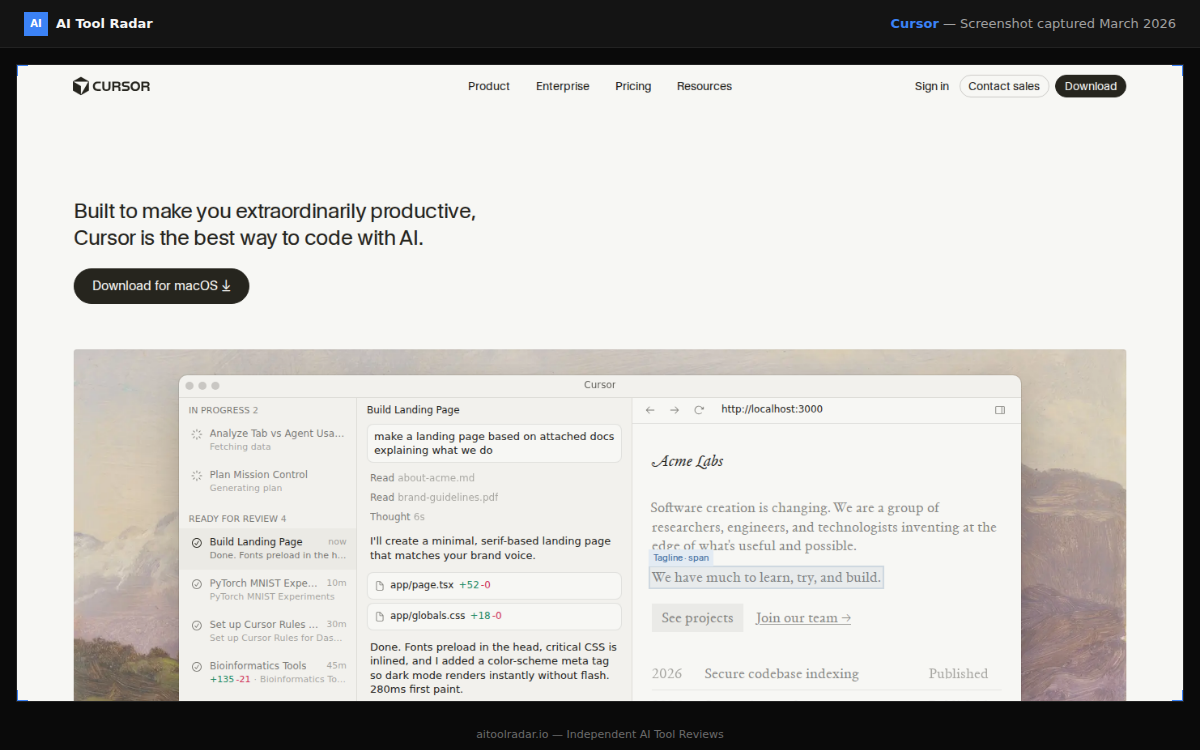
Cursor stayed independent and kept growing. Cursor closed a Series D at $29.3 billion valuation in November 2025 (CNBC). By February 2026, the company was reporting roughly $2 billion ARR (TechCrunch, 2 March 2026). In April 2026, TechCrunch reported Cursor was in talks for a new round at around $50 billion valuation, with Thrive and Andreessen Horowitz leading and Nvidia participating. The round was not yet closed as of this post.
Replit pivoted to agent-first. Replit shipped Replit Agent in 2024 and rode it to a $9 billion valuation in a Series D in March 2026 (TechCrunch), with $150 million ARR reported in September 2025. The company is targeting $1 billion ARR by end of 2026.
Vercel shipped v0 and an agent layer. Vercel's v0 launched as a generative-UI product in 2023 and was rebuilt as "the new v0" in 2025. Vercel Agent is the company's broader positioning around agentic deployments. Vercel is branding 2026 as "the year of agents" for its platform.
GitHub Copilot kept growing. Reportedly around 20 million users and roughly $800 million ARR, with continuous agent-feature additions throughout 2025-2026. Microsoft's integration advantage (VS Code is the dominant editor) means Copilot remains a major force regardless of whether it has the best AI.
What the collapsed Windsurf deal tells you#
The failure of the OpenAI-Windsurf acquisition is the most informative single event in this list, because it shows how much strategic value the acquirers assign to these products.
Three billion dollars for a two-year-old coding-IDE company is not a normal acquisition price. OpenAI made that offer because they recognised that without their own IDE, their relationship with developers is mediated through Cursor, Claude Code, or Microsoft's Copilot — and every dollar of API revenue flowing through one of those products is a dollar where OpenAI's pricing power is constrained by the IDE vendor's product choices.
When the deal collapsed, Google moved on it — not through an acquisition, but through a licensing deal for the Windsurf tech, while portions of the original team went to Cognition. Nobody wanted Windsurf to end up as an Anthropic asset or grow as an independent competitor. The fact that three of the top four labs had some stake in what happened to Windsurf tells you exactly how strategic this real estate is.
Why chat is a worse position than IDE#
A chat subscription (Claude.ai, ChatGPT, Gemini) is worth about $20/month per user. An IDE seat is worth $20-200/month per user in base subscription, plus the API revenue the user drives through the tool.
More importantly, the relationship is structurally different. Chat is switchable in one minute. The user closes one tab and opens another. The data does not move, the workflow does not move, the habit does not move.
An IDE embedds in the engineer's daily workflow, accumulates context about their codebase, integrates with their version control and deploy, and builds muscle memory. Switching an IDE is a real cost. Users who pay for Cursor or Claude Code today will still be using the same tool in six months more often than users who pay for a chat subscription, by a lot.
And the API revenue pull-through matters. When a Cursor user chooses Claude Sonnet 4.6 as their model, Anthropic gets the API revenue at the agreed rate. Anthropic has market power in that transaction. When a Claude Code user uses Anthropic's product end-to-end, Anthropic captures the full value. The IDE is not just a product — it is a funnel for compute consumption at scale, and funnels are more defensible than products.
What this tells non-engineers#
If you are not a developer, why does this matter?
Because the pattern is going to replay in other categories. Wherever knowledge work happens in specific software (legal in document review tools, finance in spreadsheets and modelling platforms, design in Figma and Adobe, sales in Salesforce-type CRMs), the same logic applies. Whoever embeds AI in the daily workflow captures more durable value than whoever sells access to a general-purpose model via chat.
Watch for the same pattern: labs either building or buying their way into the workflow surfaces of each knowledge-worker category. The early signs are already visible in legal (Harvey, Casetext), in design (Adobe's aggressive Firefly integration), and in enterprise (Microsoft's Copilot-everywhere strategy). The IDE was the first and clearest, but it will not be the last.
Practical implications#
For engineers: Use the best tool for your work. Cursor and Claude Code are both credible, with different strengths. Either is going to materially change your workflow if you have not adopted one yet.
For founders building AI products: The IDE wars tell you where value is captured. Think about whether your product is a thin chat feature or a deeply embedded workflow. Thin features will be copied. Embedded workflows might be defensible.
For investors: Valuations in this space are real but also reflect the strategic premium. Cursor at $50 billion, Replit at $9 billion, Anthropic and OpenAI at $300B+ each, Cognition at $10B+ post-Windsurf-team absorption. The ones with platform positions in specific workflows are the ones to watch. The ones relying on chat-only distribution are in a weaker position, whatever their absolute user numbers.
For business buyers: Expect IDE-shaped products pitched at non-engineer roles increasingly over 2026. Some will be transformative, some will be too ambitious for the current state of the tech. Pilot carefully.
Further reading#
- Cursor to Claude Code and Back for the direct comparison between the two dominant standalone AI IDEs.
- Vibe Coding Is a Lie for what these tools actually do in experienced hands.
- The Quiet Death of AI Agents on why narrow, embedded agents work where general ones have not.
Sources#
- Anthropic Claude Code timeline (Medium): https://medium.com/@joe.njenga/claude-code-2025-summary-from-launch-to-beast-timeline-features-full-breakdown-45e5f3d8d5ff
- OpenAI-Windsurf agreement, Bloomberg: https://www.bloomberg.com/news/articles/2025-05-06/openai-reaches-agreement-to-buy-startup-windsurf-for-3-billion
- Windsurf deal collapse, Fortune: https://fortune.com/2025/07/11/the-exclusivity-on-openais-3-billion-acquisition-for-coding-startup-windsfurf-has-expired/
- Google Jules GA: https://blog.google/technology/google-labs/jules-now-available/
- SiliconANGLE on Jules: https://siliconangle.com/2025/08/06/google-makes-jules-ai-coding-agent-available-everyone-free-paid-plans/
- Cursor Series D, CNBC: https://www.cnbc.com/2025/11/13/cursor-ai-startup-funding-round-valuation.html
- Cursor $2B ARR, TechCrunch: https://techcrunch.com/2026/03/02/cursor-has-reportedly-surpassed-2b-in-annualized-revenue/
- Cursor in talks for $50B, TechCrunch: https://techcrunch.com/2026/04/17/sources-cursor-in-talks-to-raise-2b-at-50b-valuation-as-enterprise-growth-surges/
- Replit Series D, TechCrunch: https://techcrunch.com/2026/03/11/replit-snags-9b-valuation-6-months-after-hitting-3b/
- Vercel v0 rebuild: https://vercel.com/blog/introducing-the-new-v0
- Vercel Agent docs: https://vercel.com/docs/agent