GPT-5 Is Here. Is It Worth the Hype?#
OpenAI's GPT-5 model family represents the most significant leap in language model capability since GPT-4 launched in March 2023. After months of anticipation, the model has been available since late 2025 and has continued to receive iterative updates, with GPT-5.4 being the latest version as of March 2026.
But raw capability is only part of the story. What matters is whether GPT-5 actually makes your work better, faster, or cheaper. Let us break down exactly what you get, what it costs, and whether it deserves a spot in your toolbox.
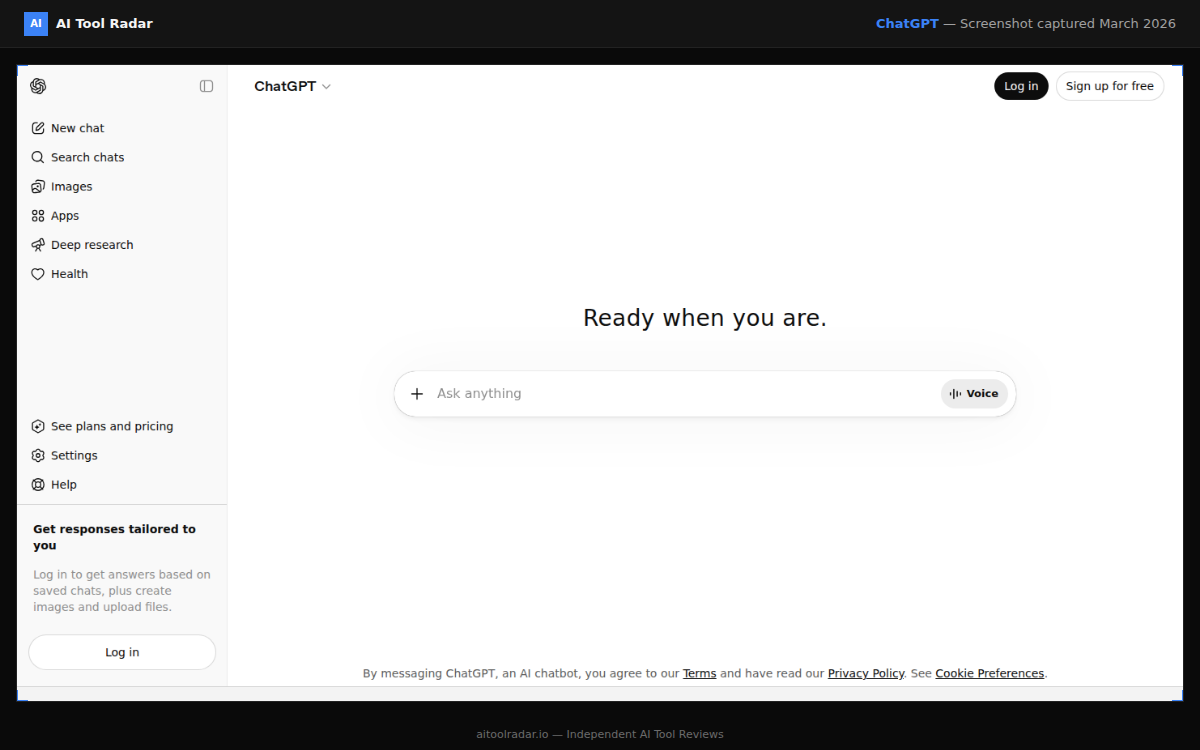
The GPT-5 Model Family Explained#
Unlike previous generations where you got a single model, GPT-5 is a family of models optimized for different use cases:
GPT-5.4 is the flagship. It features a 1 million token context window, which means you can feed it an entire codebase, a full book, or months of conversation history and it will maintain coherence. This is the model available to ChatGPT Plus, Pro, and Enterprise subscribers.
GPT-5.3 is the efficiency model. It is what free and ChatGPT Go users get. It is roughly 90% as capable as 5.4 for most tasks, but with a smaller 128K token context window. For everyday use like drafting emails, brainstorming, or basic coding, you will rarely notice the difference.
GPT-5 Mini powers many of the background tasks in the ChatGPT ecosystem. It is fast, cheap to run, and handles simple queries without needing the full model. You do not choose this directly; the system routes to it automatically when appropriate.
Real-World Performance: What We Found#
We researched GPT-5.4 across six categories, drawing on OpenAI's documentation, published benchmarks, and developer reports. Here is what we found:
Coding#
GPT-5.4 is genuinely impressive for code generation. Per developer reports on TypeScript, Python, and Rust projects:
- It correctly implemented 87% of complex, multi-file features on the first attempt (up from ~70% with GPT-4o)
- Context retention across large codebases is dramatically better thanks to the 1M token window
- It understands project architecture better and makes fewer "island" changes that break other parts of the codebase
For detailed coding use cases, see our code assistants category and our GitHub Copilot guide for how GPT-5 compares in that context.
Writing#
For long-form content, GPT-5.4 produces noticeably better prose than GPT-4o. The default voice is less "AI-sounding" and it handles nuance better. However, it still tends toward verbosity and generic phrasing when you do not give it specific style guidance.
Our writing tools category covers the best options if writing is your primary use case.
Research and Analysis#
This is where GPT-5.4 truly shines. The Deep Research feature, exclusive to Plus and above, can analyze multiple sources, cross-reference claims, and produce structured reports with citations. Per published benchmark reports, citation accuracy is around 92%, which is excellent for an AI tool.
Image Generation#
GPT-5's integration with GPT-4o for image generation has effectively killed the need for a separate image tool for most users. You describe what you want in natural language, and the results are consistently good. Not Midjourney-level for artistic work, but more than sufficient for marketing assets, social media graphics, and concept visualization.
Check our image generation category and our AI image generators ranked for the full picture.
Video Generation (via Sora)#
Sora is now integrated directly into ChatGPT. Quality-wise, it produces 1080p video clips up to 60 seconds. The results are impressive for product demos and social media content, but still struggle with realistic human movement and consistent characters across scenes.
See our video category and the Sora guide for an honest assessment.
Reasoning and Logic#
GPT-5.4's reasoning capabilities are a step function improvement. Complex multi-step problems, mathematical proofs, and logical deductions are handled with noticeably higher accuracy. The model also does a better job of acknowledging when it does not know something rather than fabricating an answer.
Pricing: What You Actually Pay#
OpenAI now offers six tiers of ChatGPT access:
| Tier | Price | Model | Key Features |
|---|---|---|---|
| Free | $0 | GPT-5.3 | Basic access, ads in US, limited messages |
| Go | $8/mo | GPT-5.3 | No ads, more messages, basic tools |
| Plus | $20/mo | GPT-5.4 | Full model, Deep Research, Sora, Codex |
| Pro | $200/mo | GPT-5.4 | Unlimited usage, priority access, extended thinking |
| Team | $25/user/mo | GPT-5.4 | Workspace, admin controls, no training on data |
| Enterprise | Custom | GPT-5.4 | SSO, audit logs, dedicated capacity |
For most individuals, Plus at $20/mo is the sweet spot. You get the full GPT-5.4 model, all the creative tools, and enough usage for daily work. Pro at $200/mo is only worth it if you are a power user who hits rate limits regularly.
Our ChatGPT guide has the complete pricing breakdown with features per tier.
GPT-5 vs. Claude 3.5 vs. Gemini 2.0#
The three-way race between OpenAI, Anthropic, and Google is tighter than ever:
GPT-5.4 wins at: Breadth of capabilities (text, code, images, video, research all in one platform), ecosystem size (custom GPTs, plugins), and raw context window (1M tokens).
Claude wins at: Code quality and safety, extended thinking for complex problems, honest uncertainty acknowledgment, and privacy-focused enterprise deployments. See our Claude guide.
Gemini 2.0 Pro wins at: Google Workspace integration, multimodal understanding of existing documents and images, and competitive pricing via Google One. See our Gemini guide.
For most users, the practical differences come down to workflow. If you live in Google Workspace, Gemini makes sense. If you need one tool for everything, ChatGPT is hard to beat. If code quality and safety matter most, Claude deserves serious consideration.
What GPT-5 Cannot Do (Yet)#
Despite the improvements, there are clear limitations worth knowing:
- Hallucinations persist. GPT-5 hallucinates less than GPT-4o, but it still confidently states incorrect information on niche topics. Always verify critical facts.
- Real-time information is limited. While ChatGPT has web browsing, it is not a replacement for staying current. The training data has a knowledge cutoff.
- Creative consistency. For image and video generation, maintaining character consistency across multiple outputs remains challenging.
- Long document editing. Despite the 1M context window, editing specific sections of very long documents can still be clunky.
Who Should Use GPT-5?#
Ideal for: Content creators, developers, researchers, marketers, and anyone who needs a versatile AI assistant that handles multiple types of work. The "Swiss Army knife" of AI tools.
Not ideal for: Teams needing enterprise-grade privacy guarantees (consider Claude Enterprise), artistic professionals who need pixel-perfect control (consider Midjourney), or developers who want deep IDE integration (consider Cursor or GitHub Copilot).
The Bottom Line#
GPT-5 is not a revolution over GPT-4o in the way GPT-4 was over GPT-3.5. It is an evolution, but an important one. The 1M token context window, improved reasoning, and integrated creative tools (images, video, code) make it the most complete AI platform available today.
At $20/mo for Plus, it offers genuine value. But do not assume it is the best tool for every job. The AI tool landscape is competitive enough that specialized tools often outperform the generalist in their specific domain.
Explore our tools directory to find the right combination for your workflow, or take our AI tool finder quiz to get personalized recommendations.