
This site contains affiliate links. We may earn a commission at no extra cost to you. This helps us keep the site running and continue providing free guides and comparisons.
The Bottom Line#
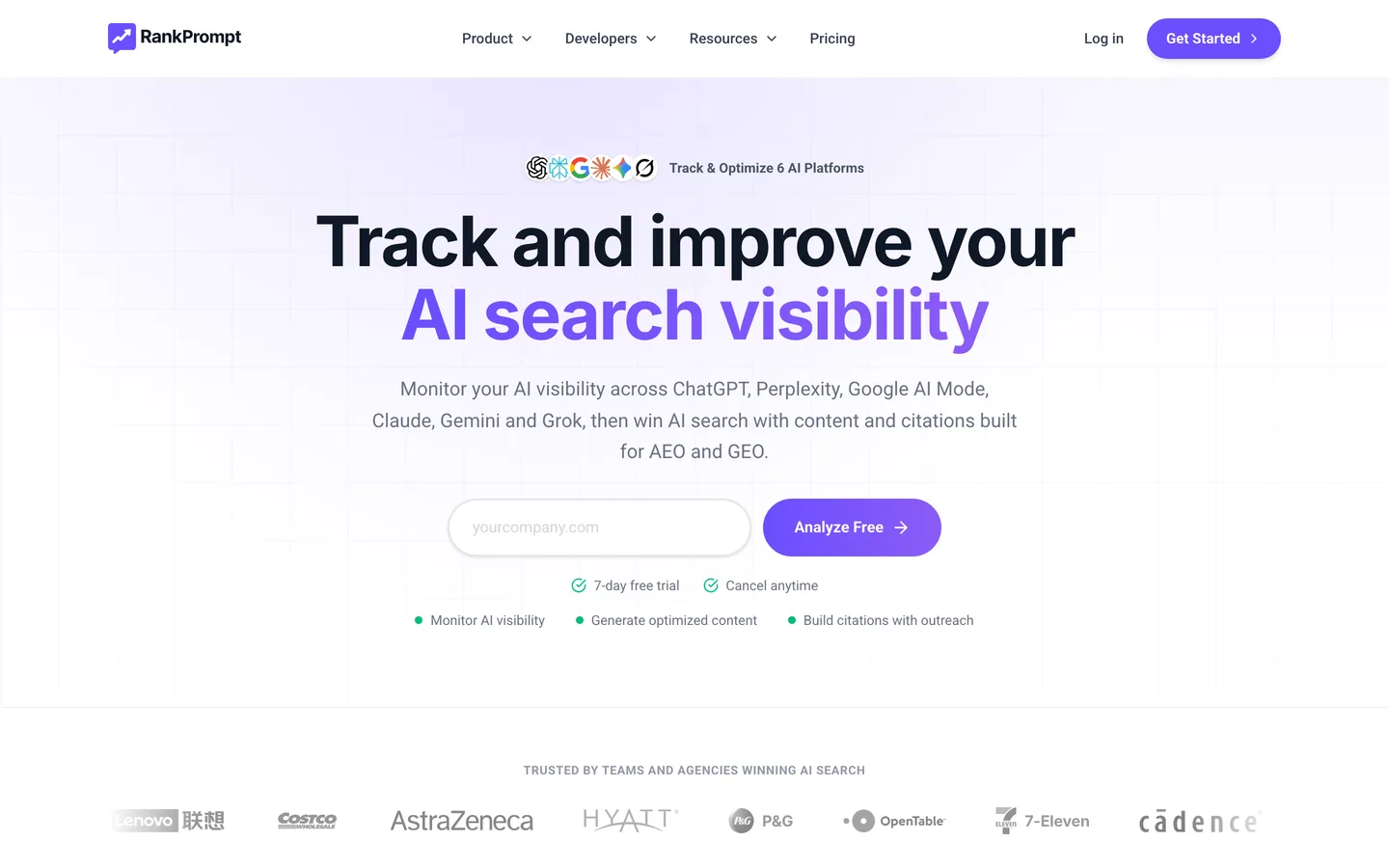
RankPrompt is one of the most complete Generative Engine Optimization (GEO) platforms available at mid-market pricing in 2026. Where most AI-visibility tools only monitor, RankPrompt bundles monitoring, content generation and outreach in one dashboard, and it tracks more AI engines than most rivals: ChatGPT, Perplexity, Google AI Mode, Claude, Gemini and Grok. It is built for the shift that is already underway, as AI assistants increasingly answer questions that used to send a click to your website. It is not a magic ranking button, and the credit system means heavy users will feel the limits, but for agencies, founders and SEO teams that want to start measuring and improving their AI search visibility now, it is a practical, affordable place to begin.
Rating: 4.3/5 | Price: $49 / $89 / $149 per month | Free plan: No (7-day trial) | Last verified: June 2026
Score Breakdown
Key Facts#
- Pricing: Starter ($49/mo, $470/yr), Pro ($89/mo, $855/yr), Agency ($149/mo, $1,430/yr). Annual billing saves roughly 20%.
- Free tier: No. All paid plans include a 7-day free trial with 50 bonus credits. Credit card required.
- Credits: 150 / 500 / 1,000 per month. 1 credit per prompt analysis, 10 per AI-generated article, 10 per brand audit (plus 1 per citation page analysed), 5 per Lighthouse audit.
- AI platforms tracked: ChatGPT, Perplexity, Google AI Mode, Claude, Gemini, Grok.
- Integrations: Google Analytics 4, Google Search Console, WordPress.
- Background: Founded mid-2025 in Miami by marketing-agency founders who built it as an internal tool before opening it publicly.
What Is RankPrompt and Who Is It For?#
RankPrompt is a GEO platform: a tool for measuring and improving how often, and how favourably, your brand shows up when people ask AI assistants questions. Instead of tracking your position on a Google results page, it tracks whether ChatGPT, Perplexity, Gemini, Claude, Grok or Google's AI Mode mention you, cite you, or recommend a competitor instead. Each tracked prompt produces a visibility score from 0 to 100%, and the platform shows which sources the AI pulled its answer from.
The tool targets three groups: agencies that need to report AI visibility to clients, founders and SaaS teams who see AI search becoming a real acquisition channel, and in-house SEO teams adding GEO to their existing work. It competes with monitoring-only tools and with enterprise GEO platforms that cost several times more. Its pitch is breadth at a reasonable price: six engines, content generation, audits and outreach in one place. For a content-side view of the same trend, our Frase guide covers a tool that adds AI-citation scoring to traditional SEO writing.
How We Built This Guide#
This guide is based on RankPrompt's official product and pricing pages, verified in June 2026, plus public information about the company and the broader GEO research that defines the category. RankPrompt is a young product (launched mid-2025), so independent long-term review data is still limited. Where we cite the company's own usage figures, we say so; where we cite GEO effectiveness, we link the underlying academic study rather than vendor marketing.
Our sources include:
- RankPrompt's official product, monitoring and pricing pages (verified June 2026)
- The original Generative Engine Optimization research paper (Princeton, Georgia Tech, IIT Delhi, Allen Institute for AI)
- Third-party tool directories and early reviews
- Public company background
Why RankPrompt
Visit provider- Six-Platform AI Visibility MonitoringRankPrompt's core is tracking brand mentions across six AI engines: ChatGPT, Perplexity, Google AI Mode, Claude, Gemini and Grok.
- Citation TrackingFor each answer, RankPrompt shows which sources the AI used.
- Content StudioThe Content Studio generates articles designed to be cited by AI assistants, not just to rank on Google.
- Competitor AnalysisRankPrompt automatically detects and tracks competitors that appear in the same AI answers as you.
- SEO Audits and Outreach
Features in Depth#
Six-Platform AI Visibility Monitoring#
RankPrompt's core is tracking brand mentions across six AI engines: ChatGPT, Perplexity, Google AI Mode, Claude, Gemini and Grok. You define the prompts that matter for your category, and the platform runs them, records whether you are mentioned, scores your visibility from 0 to 100%, and tracks how that score changes over time. This breadth matters because answer patterns differ between engines: a brand that ChatGPT recommends may be invisible in Perplexity, and you cannot fix what you cannot see.
Citation Tracking#
For each answer, RankPrompt shows which sources the AI used. This is the practical heart of GEO: if you know that ChatGPT keeps citing three specific pages when answering questions in your niche, you know which pages to target for mentions, guest content or outreach. Citation tracking turns "we want to show up in AI" into a concrete list of source pages to influence.
Content Studio#
The Content Studio generates articles designed to be cited by AI assistants, not just to rank on Google. AI-generated articles cost 10 credits each. The output is structured the way generative engines prefer: clear definitions, factual density and named sources. This is the same principle the academic GEO research identified, that content with verifiable statistics and citations is more likely to be pulled into AI answers.
Competitor Analysis#
RankPrompt automatically detects and tracks competitors that appear in the same AI answers as you. Instead of manually guessing who you are up against in AI search, you see which brands the engines surface for your prompts and how your visibility compares. For agencies, this is also a sales tool: showing a prospect that a competitor dominates ChatGPT answers in their category is a concrete, visual argument.
SEO Audits and Outreach#
Beyond AI monitoring, RankPrompt runs technical SEO audits with Lighthouse and Core Web Vitals scoring (5 credits each) and includes automated email outreach for citation and backlink campaigns on the Pro and Agency plans. Agent Mode, an always-on AI SEO assistant, answers questions about your visibility and runs on a small separate monthly budget ($5 to $15 depending on tier). GA4, Search Console and WordPress integrations connect the platform to your existing analytics and publishing stack.
Pros
- Tracks six AI engines in one dashboard (ChatGPT, Perplexity, Google AI Mode, Claude, Gemini, Grok), broader coverage than most GEO tools
- Bundles monitoring, citation tracking, content generation and outreach instead of monitoring alone
- Mid-market pricing from $49/month, well below enterprise GEO platforms that run into the hundreds or thousands per month
- Unlimited brands on every plan, plus 50+ languages and city-level tracking for local and multi-market work
- 7-day free trial with 50 bonus credits lets you run real reports before paying
- Useful as an agency reporting and sales tool: visibility scores and competitor comparisons are client-ready
Cons
- Credit-based pricing: at 10 credits per article and 10 per brand audit, the 150-credit Starter plan is consumed quickly by active use
- New product (launched mid-2025) with a limited independent review track record and shorter data history than established SEO tools
- No free plan, and the 7-day trial requires a credit card
- Agent Mode runs on a small separate monthly budget that heavy users may exhaust
- GEO as a discipline is young: visibility scores are directional, and no tool can guarantee AI engines will cite you
Pricing Breakdown#
RankPrompt offers three tiers, all credit-based, as of June 2026:
Starter ($49/month, $470/year) — 150 credits per month, all six AI platforms, unlimited brands, Content Studio, SEO audits, and GA4, Search Console and WordPress integrations. Includes a $5/month Agent Mode budget. Best for a single brand or a solo consultant getting started with GEO.
Pro ($89/month, $855/year) — 500 credits per month, everything in Starter plus email outreach campaigns, white-label exports, and a $10/month Agent Mode budget. The practical starting point for agencies and teams that need client-ready reports and more monitoring volume.
Agency ($149/month, $1,430/year) — 1,000 credits per month, everything in Pro plus team collaboration, priority support, and a $15/month Agent Mode budget. Built for agencies tracking many brands and clients at once.
Free trial: All paid plans include a 7-day free trial with 50 bonus credits. A credit card is required, and you are not charged until the trial ends. You can cancel any time during the trial.
How credits work: 1 credit per prompt analysis, 10 credits per AI-generated article, 10 credits per brand audit (plus 1 credit for each citation page analysed), and 5 credits per Lighthouse audit. This is the single most important thing to understand before buying: if you plan to generate content as well as monitor, budget your credits accordingly. Monitoring a focused set of prompts is cheap; generating dozens of articles is not. Annual billing saves roughly 20% across all tiers.
| Plan | Price | Credits | Key Features |
|---|---|---|---|
| Starter | $49/mo ($470/yr) | 150/mo | All 6 AI platforms, unlimited brands, Content Studio, SEO audits |
| ⭐ Pro | $89/mo ($855/yr) | 500/mo | Everything in Starter + email outreach, white-label exports |
| Agency | $149/mo ($1,430/yr) | 1,000/mo | Everything in Pro + team collaboration, priority support |
Starter
- 150 credits/month
- All 6 AI platforms
- Unlimited brands
- Content Studio + SEO audits
- GA4 + Search Console + WordPress
- $5/mo Agent Mode budget
Pro
- 500 credits/month
- Everything in Starter
- Email outreach campaigns
- White-label exports
- $10/mo Agent Mode budget
Agency
- 1,000 credits/month
- Everything in Pro
- Team collaboration
- Priority support
- $15/mo Agent Mode budget
Similar Tools Worth Considering#
- Frase: A content-first SEO tool that added AI-citation (GEO) scoring and AI search tracking. It optimises individual articles for both Google and AI engines rather than monitoring brand visibility across a whole market. Cheaper entry point ($39/mo annual). Choose Frase if your priority is writing citation-friendly content; choose RankPrompt if your priority is measuring and tracking visibility across many prompts and engines.
- Profound, Otterly.AI and Peec AI: Other tools in the GEO/AI-visibility category. Profound sits at the enterprise end with pricing well above RankPrompt; Otterly.AI and Peec AI are closer in spirit but typically cover fewer engines or focus on monitoring only. RankPrompt's differentiator is combining six-engine monitoring with content generation and outreach at one price.
- Traditional SEO suites (Semrush, Ahrefs): Still essential for backlinks, keyword research and Google rank tracking, and both are adding AI-search features. They are complements to a dedicated GEO tool, not replacements, in 2026.
For a broader overview, see our Best AI Tools 2026 guide, and read how GEO actually works for the strategy behind the tool.
Who Should Use RankPrompt?#
Best for agencies: Track AI visibility across many client brands, generate client-ready reports with visibility scores and competitor comparisons, and use white-label exports on the Pro and Agency plans. The competitor analysis doubles as a pitch tool.
Best for founders and SaaS teams: If AI search is becoming a real source of signups, RankPrompt lets you measure it, see which sources AI engines cite in your category, and act on it before competitors do.
Best for in-house SEO teams adding GEO: The six-engine monitoring, citation tracking and audits slot into an existing SEO workflow and give you data to justify GEO work internally.
NOT for you if you only need traditional Google rank tracking and backlinks (Semrush or Ahrefs are more complete for that), you want a free tool (RankPrompt has no free plan), or you are not yet producing or monitoring content where AI citations matter. GEO is most valuable once you already have content worth getting cited.
RankPrompt's biggest strength is coverage at a fair price: six AI engines, plus content and outreach, in one dashboard for less than many single-purpose monitoring tools. Its biggest weakness is the youth of both the product and the discipline: visibility scores are directional, the credit system rewards focused use over heavy generation, and the long-term review record is still thin. Start with the 7-day trial, set up the prompts that matter for your category, and see how visible you actually are before committing.
FAQ#
Is RankPrompt free to use in 2026?#
No. RankPrompt does not have a free plan. All three paid plans (Starter $49/mo, Pro $89/mo, Agency $149/mo) include a 7-day free trial with 50 bonus credits. A credit card is required, but you are not charged until the trial ends, and you can cancel any time during it.
What is GEO and how is it different from SEO?#
GEO (Generative Engine Optimization) is about being mentioned and cited in answers from AI assistants like ChatGPT, Perplexity and Gemini, rather than ranking on a traditional Google results page. SEO optimises for a blue link in a list; GEO optimises for being the source an AI quotes. RankPrompt measures the GEO side: whether and how often AI engines surface your brand.
How many AI platforms does RankPrompt track?#
Six: ChatGPT, Perplexity, Google AI Mode, Claude, Gemini and Grok. That is broader coverage than most competing tools, several of which track only one or two engines.
How does the credit system work?#
Each plan includes a monthly credit allowance (150 / 500 / 1,000). A prompt analysis costs 1 credit, an AI-generated article 10 credits, a brand audit 10 credits (plus 1 per citation page analysed), and a Lighthouse audit 5 credits. Monitoring a focused prompt set is cheap; generating large volumes of content is what consumes credits fastest, so plan around your main use case.
Is RankPrompt better than Frase?#
They solve different problems. Frase is a content tool that optimises individual articles for SEO and AI citation; RankPrompt is a monitoring platform that tracks your brand's visibility across six AI engines and many prompts. If you mainly write content, Frase is the better fit. If you mainly need to measure and report AI visibility, RankPrompt is. Many teams use a writing tool and a monitoring tool together.