The short version#
The transparency duties in Article 50 of the AI Act have applied since August 2, 2026. For anyone working with AI voices, so podcast intros, explainer videos, phone greetings, audiobook production, that means two things that reporting keeps mixing up:
- Machine-readable marking is the vendor's job. ElevenLabs, OpenAI and Google embed inaudible watermarks and provenance metadata into the generated files.
- Visible disclosure is your job as a deployer. No vendor can do it for you.
Miss that split and you make one of two mistakes: rely on the watermark and skip the disclosure, or label every generated file out of caution, including cases where nothing is required.
We wrote up the full Article 50 overview here. This post covers only the audio case and how to implement it.
Not legal advice. For your specific situation, talk to a lawyer.
What the Commission published on July 20#
The European Commission released its final Article 50 guidelines on July 20, 2026, eleven days before the rules took effect (NicFab, Stibbe). Three points matter in practice.
Timing. Disclosure must happen at the latest at the time of the first interaction. For audio that means before someone hears the voice, not in the credits.
Clarity. The standard is a "clear and distinguishable manner" that also meets accessibility requirements. The guidelines explicitly name what fails that bar: disclosures buried in terms of service, faint or barely legible labels, vague notifications.
The obviousness exception. Disclosure is not required where AI involvement is obvious "from the point of view of a natural person who is reasonably well-informed, observant and circumspect." The guidelines warn against leaning on this and require a two-step assessment: identify the target audience, then realistically judge how observant an average member of that group actually is.
For synthetic voices that test almost always goes against you. Modern text-to-speech is no longer recognizable as AI to ordinary listeners. That is the entire selling point.
The division of labor nobody explains#
Article 50 splits the burden across two roles, and both duties run in parallel.
| Who | What | From when | |
|---|---|---|---|
| Paragraph 2 | Provider (ElevenLabs, OpenAI, Google) | Machine-readable marking of output | August 2, 2026; for systems already on the market before that: December 2, 2026 |
| Paragraph 4 | Deployer (you) | Visible disclosure to your audience | August 2, 2026 |
The point that saves the most trouble in practice: the vendor's watermark does not satisfy your disclosure duty. It is inaudible, which is precisely its purpose. A listener learns nothing from it. Your duty under paragraph 4 addresses humans, not detectors.
Conversely, if your vendor supplies the machine-readable marking, your only job is to leave it intact in your pipeline. Metadata is easily lost during rendering, conversion and editing.
What ElevenLabs actually delivers#
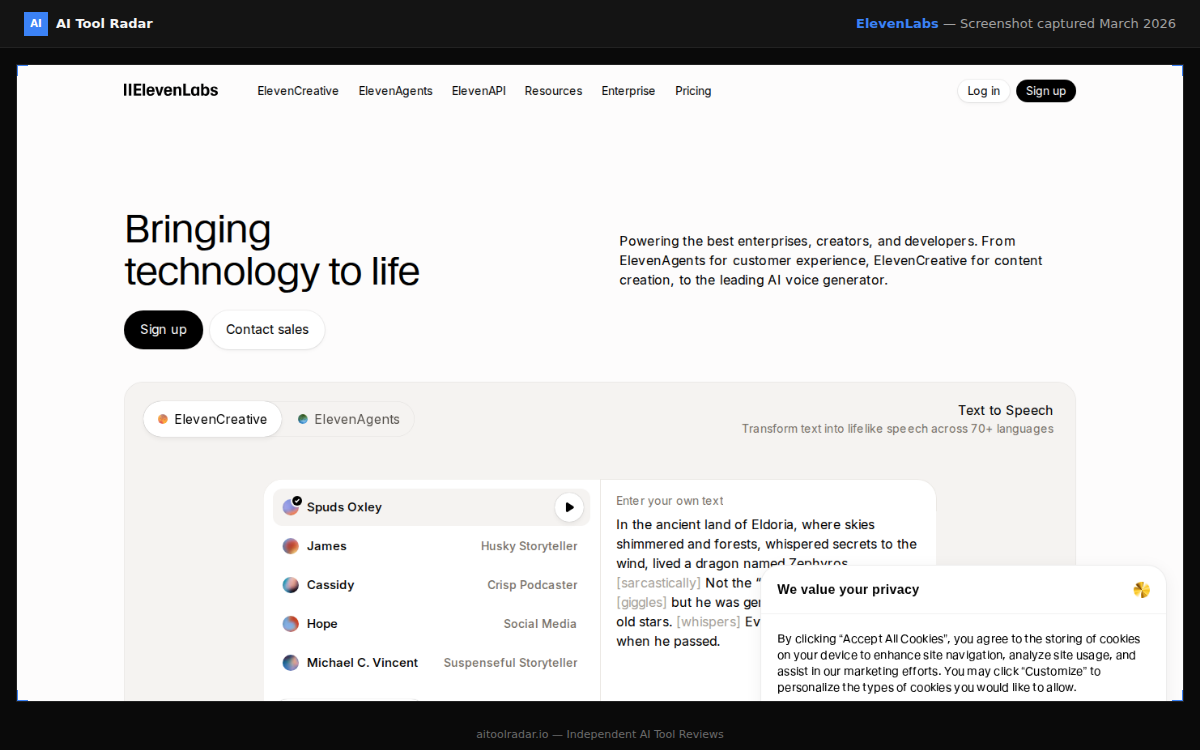
To rely on the provider duty being met, you need to know who meets it. For ElevenLabs the record is verifiable.
On June 25, 2026 ElevenLabs rolled out SynthID from Google DeepMind. The method hides a sound pattern in the audio file that is imperceptible to the human ear but readable through the free ElevenLabs Audio Detector. Each file gets its own pattern, and according to the vendor it survives common transformations such as compression and speed changes.
Two limitations worth knowing:
- The rollout started with text-to-speech generations from free users. Expansion to all audio generations was announced but not complete at the time of the announcement. If you produce on a paid plan, check your specific file against the detector when it matters.
- ElevenLabs states that SynthID complements an existing ecosystem that also includes C2PA credentials. C2PA metadata is fragile, though, and does not survive many export steps.
That is what can be documented. What ElevenLabs explicitly does not have is an AI Act certification, and none exists for Article 50 anyway. There is no seal that releases you from your deployer duty.
Wordings that meet the standard#
The guidelines prescribe no exact wording, only a standard: clear, distinguishable, timely, accessible. What follows in practice:
For videos with AI voiceover
The narration in this video was generated with AI.
As on-screen text in the first seconds, not only in the video description. Relying on the description assumes it gets read, which autoplay feeds do not deliver.
For podcasts and audio-only formats
Note: this episode was produced with an AI voice.
Spoken at the start. A line in the show notes alone fails the timing requirement, because the listener hears the voice first.
For phone systems and voice assistants
Paragraph 1, the interaction case, applies on top here. The notice belongs at the start of the call:
You are speaking with an AI assistant.
Where restraint is allowed
For evidently artistic or satirical work the disclosure may be less prominent. It does not disappear, it may just be placed less intrusively.
Where it probably does not apply to you
Internal use without publication, prototypes and tests do not trigger the public disclosure duty. Once the material reaches clients or the open web, it is published.
On the penalty range#
For Article 50 breaches the analyses cite an EU ceiling of up to 15 million euros or 3 percent of worldwide annual turnover, whichever is higher (Bratby Law). That figure is the upper limit. Member states set the actual framework within it, and designation of the competent supervisory authorities in Germany and Austria was not everywhere complete at the time of writing.
Practically, for a small business: the number does not describe your risk. But one line of on-screen text costs you ten minutes, and arguing about whether you needed it costs more.
What this post does not cover#
We do not cover image and video generation here, even though paragraph 4 catches them just as much. The deepfake definition, and the question of when an AI illustration counts as one, needs its own treatment. Also out of scope: how this interacts with copyright when cloning real voices, which is an entirely different legal question from labeling, and the consent requirements for voice cloning. For the high-risk regime and GPAI duties see the overview post.
We also did not independently measure whether SynthID is applied at every ElevenLabs output tier. Those details come from the vendor announcement. If you rely on it, check your own file against the detector.
Sources#
- ElevenLabs: Detecting audio generated by ElevenLabs with SynthID (June 25, 2026)
- NicFab: AI Act transparency obligations, the Commission publishes its Article 50 guidelines
- Stibbe: The AI Act's transparency obligations, rules, scope and timeline
- FLI: The EU AI Act's transparency rules, a practical guide to Article 50
- Bratby Law: AI Act transparency obligations, 2 August 2026